Introduction
Recent landscape design has expanded beyond the creation of spaces or the formation of landscapes into a process of interpreting and coordinating complex urban and environmental issues (Cortesão & Lenzholzer, 2022). Climate change and urbanization are increasing environmental uncertainty in urban space, and in response, landscape design has become closely linked to climate adaptation, ecological restoration, and the creation of sustainable urban environments (Alizadeh & Hitchmough, 2019; Ramyar et al., 2021). As the perspective of interpreting cities and ecology not as separate objects but as a single complex system has expanded, landscape design now plays a role in reading environmental conditions, urban structures, patterns of use, and ecological processes together and translating them into design strategies (Musacchio, 2025).
These changes also affect the content and methods of landscape design education. In landscape design education, Geographic Information System (GIS), spatial analysis, and evidence-based design are not entirely new topics; rather, they have already been discussed as means of interpreting the environmental and spatial conditions of a site and establishing a basis for design judgment (Brown & Corry, 2020). Recently, as the range of available technologies has broadened to include data analysis, digital modeling, visualization, simulation, and AI-based design-support tools, the ways in which such analysis and representation are addressed within curricula are also changing (Fricker et al., 2023; Zwangsleitner et al., 2024). Thus, recent changes in landscape design education are not limited to adding instruction in new tools; they also concern how analytical results are interpreted and connected to design concepts, spatial strategies, representational outputs, and project implementation processes.
International research on landscape design education has discussed ecological and climatic issues, studio-based learning, project implementation, and the use of digital technologies in combination. Hsu & Ou (2022) integrated sustainable development goals (SDG)-related topics with design-based learning in sustainable landscape design education, structuring coursework so that students could address the concept of sustainability within the process of completing design assignments. Bartelse et al. (2024) examined sustainability, technological change, professional competencies, and curricular innovation as major changes in landscape education, arguing that landscape design education must reflect shifting socio-environmental conditions and professional contexts simultaneously. These studies show that ecological and environmental issues can be addressed as criteria for defining design problems and constructing design alternatives in landscape design education.
This trajectory is also linked to the importance of studio education and project-based learning (PBL). In landscape design education, the studio has long been treated as a core mode of learning through which students interpret site conditions, develop design proposals, and concretize design judgments through presentation and critique (Bartelse et al., 2024; Ezennia & Agbonome, 2025). Ezennia & Agbonome (2025) viewed critique and feedback in the design studio as playing an important role in the formation of students’ design thinking, while Andalib & Monsur (2024) examined how virtual reality (VR)-based learning can enhance site understanding and learning engagement in landscape education. Accordingly, the international trajectory of landscape design education can be understood not as a focus on the introduction of digital tools per se, but as a pedagogical approach that treats ecological and climatic issues as design assignments and connects them to studio-based project implementation, representation, and critique.
In South Korea, studies have also examined the content and methods of landscape design education. Kim (2016) analyzed syllabi for second- and third-year landscape design courses at four-year universities in South Korea and suggested that syllabi can serve as materials for diagnosing the objectives, content, and methods of design education. Na (2021) compared computer media curricula in landscape architecture departments in South Korea and abroad and examined the need for, and directions for improving, computer media education, including digital representation techniques, GIS, three-dimensional terrain modeling, and digital fabrication. More recently, Han & Park (2025) conducted experiments and interviews on the use of generative AI in a landscape design studio, analyzing how AI can improve the efficiency of the design process and visualization capabilities while supporting learners’ creative thinking.
These studies are meaningful in that they address important issues such as syllabi, digital technologies, and the use of generative AI in landscape design education. However, each study focuses on a specific course type, a specific technological domain, or an individual studio experiment, and therefore has limitations in explaining the relational structure through which educational content appears across design and studio courses at multiple universities. In particular, there has not yet been sufficient analysis of how educational elements such as environment and ecology, analysis, representation, and project implementation appear in design courses and studio courses, respectively, or of what kinds of integrated connective structures they form.
To address these limitations, it is necessary to jointly examine the relationship between design courses and studio courses that constitute landscape design education. Both course types are core domains of landscape design education, yet they differ in educational content and modes of operation. Design courses are related to the process of constructing design proposals on the basis of spatial concepts, understanding of environmental and urban structures, planning methods, and site analysis. By contrast, studio courses are closely linked to pedagogical formats in which students develop design proposals around real or hypothetical sites or projects and concretize the design process through presentation, critique, feedback, and the production of final outcomes (Bartelse et al., 2024; Ezennia & Agbonome, 2025). However, the two course types are not simply separate domains such as theory and practice. The environmental and ecological concepts, site analysis, and planning-oriented thinking addressed in design courses can serve as the foundation for project implementation in studio courses, while representation, presentation, critique, and feedback in studios operate as processes that translate analysis and concepts into design proposals (Xi & Wang, 2022). Therefore, to understand the structure of landscape design education in South Korea, it is necessary not only to analyze design courses and studio courses separately but also to examine their commonalities, differences, and integrated connective structure.
Keyword network analysis can be used as a method for identifying this course structure. Visualization of similarities viewer (VOSviewer) visualizes link strength and cluster structures based on co-occurrence relationships among keywords, making it suitable for interpreting relationships among topics that are difficult to identify through simple frequency analysis alone (van Eck & Waltman, 2010; Waltman et al., 2010). Keyword co-occurrence and bibliometric network analyses have also been used to identify the structures of major topics, research trends, and relationships among themes in accumulated literature or textual data (Donthu et al., 2021; Huang et al., 2021; Zhao et al., 2018). In landscape and urban planning, Gobster (2014) conducted text mining on 40 years of articles in Landscape and Urban Planning to analyze changes in research topics and the evolution of major interests over time. In education, Narong & Hallinger (2023) analyzed 5,615 Scopus-indexed publications on service learning using citation, co-citation, and keyword co-occurrence analysis to identify the knowledge base and major thematic clusters of service-learning research, while Martins et al. (2024) used VOSviewer to analyze 896 publications on e-learning adoption and identify core themes and research trends. These studies demonstrate that analyzing accumulated textual materials from a network perspective makes it possible to understand thematic structures and relationships within a field rather than merely listing the content of individual materials.
The reason this study employs keyword network analysis is closely related to this point. Syllabi and course descriptions contain essential information about courses, including course titles, instructional objectives, main content, weekly topics, assignments, and project implementation methods. Therefore, by examining materials from design and studio courses across multiple universities, it is possible to identify not only which educational elements repeatedly appear in landscape design education, but also how those elements are organized in relation to one another. For example, the simple frequency of keywords such as environment, ecology, analysis, studio, presentation, and program is insufficient to explain the structure of landscape design education. However, by analyzing the combinations in which these keywords appear, the differences in their connections between design and studio courses, and the relational network they form in the integrated network, the course structure of landscape design education can be interpreted not as a list of individual topics but as a relational network among educational elements.
Accordingly, this study collected syllabi and course descriptions for design and studio courses offered by landscape architecture departments at South Korean universities in the 2025 academic year and conducted a VOSviewer-based keyword network analysis. Specifically, it analyzed the design-course network, the studio-course network, and the integrated design-and-studio network separately and compared their major keywords and connective structures. Through this process, the study interprets how ecological and environmental thinking, analysis-based design, representation, and project implementation are relationally organized in landscape design education in South Korea, and derives implications for linking design and studio courses and for future curriculum organization.
This study addresses the following research questions. First, what keywords appear centrally in design and studio courses offered by landscape architecture departments in South Korea? Second, how do design courses and studio courses differ in terms of keyword network structure and connective relationships? Third, how can the major educational trends and structural characteristics of landscape design education in South Korea be interpreted through integrated network analysis, and what implications can they provide for future curriculum organization?
Methods
This study conducted a keyword network analysis to identify the structure and tendencies of educational content appearing in design and studio courses in landscape architecture departments in South Korea as of the 2025 academic year. The analytical data were collected from syllabi and course descriptions available in landscape architecture curricula in South Korea, and major keywords included in course titles, course objectives, course descriptions, and weekly topics were selected as the units of analysis. The analytical procedure consisted of defining the research scope, collecting data, classifying courses, extracting and preprocessing keywords, constructing networks, and analyzing and interpreting the results (Fig. 1).

The subjects of analysis were design- and studio-related courses that could be identified in landscape architecture departments in South Korea as of the 2025 academic year. Universities were selected on the basis of whether course titles and class content could be confirmed through syllabi or course descriptions. Ultimately, course data from 22 universities were collected, and the analytical dataset comprised 163 courses in total: 102 design courses and 61 studio courses (Table 1).
Design courses and studio courses were classified not solely by course title, but by reviewing course objectives, course descriptions, weekly topics, and assignment formats together. Design courses were defined as courses centered on learning design concepts, spatial planning, environmental analysis, planning methods, and design techniques. Studio courses were classified as courses centered on implementing projects based on real or hypothetical sites and on design development, presentation, critique, feedback, and the production of final outcomes. This distinction is connected to the discussion that courses dealing with design concepts and methods and studio courses centered on project implementation play different educational roles (Bartelse et al., 2024; Ezennia & Agbonome, 2025).
In particular, courses were not automatically classified as studio courses simply because their titles included the term practice. Even when courses such as Garden Design Practice or Planting Design Practice included practical components, they were classified as design courses when the primary focus of instruction was on learning design concepts, design techniques, and spatial organization methods. By contrast, courses such as Park and Open Space Design Studio, Digital Design Studio, Capstone Design, and Comprehensive Design were classified as studio courses when site-based project implementation and the production of final outcomes were presented as central components (Table 2).
The formats in which universities provided syllabi and course descriptions varied. Some materials included year level, course classification, and theoretical/practical contact hours, but it was difficult to verify these items using consistent criteria across all courses. Therefore, to ensure data consistency, this study did not use year-level distribution, required/elective status, or theoretical/practical classification as major analytical variables. Instead, it constructed the analytical dataset around course titles, course objectives, course descriptions, and weekly topics, which could be commonly identified across the entire dataset.
Keywords were extracted from course titles, course objectives, course descriptions, and weekly topics presented in the syllabi and course descriptions. The extraction was limited to terms directly related to the content of landscape design education, with a focus on words associated with design themes, spatial and design objects, analytical methods, planning and design processes, modes of representation, and project implementation. For example, keywords describing the main content or class activities of courses, such as environment, ecology, urban, park, green space, analysis, GIS, diagram, studio, presentation, and critique, were included.
The extracted keywords were preprocessed to make them suitable for network analysis. First, keywords presented in Korean were standardized in English, and differences in capitalization and singular/plural forms in English were normalized. For example, green spaces was integrated into green space. Terms with similar meanings were also merged into a single representative keyword, while general information not directly related to educational content, such as university names, department names, and credits, was excluded from the analysis.
Based on the preprocessed keywords, a course-level co-occurrence network was constructed. Each course was set as one document unit, and pairs of keywords that appeared together within the same course were defined as co-occurrence relationships. For example, when environment, ecology, and analysis were extracted together from a single course record, the keyword pairs environment-ecology, environment-analysis, and ecology-analysis were generated. When the same keyword pair appeared repeatedly across multiple courses, the frequency was aggregated and treated as the link weight.
The network data were constructed in source-target-weight format. Source and target refer to the two connected keywords, while weight indicates the frequency with which the keyword pair appeared together in the entire course dataset (Table 3). This approach was intended to identify not only the frequency of occurrence of individual keywords, but also which other keywords specific educational content was addressed with. Network datasets were then constructed separately for the 102 design courses, the 61 studio courses, and the complete integrated set of 163 courses.
| Source | Target | Weight |
|---|---|---|
| Ecology | Environment | 89 |
| Analysis | Environment | 88 |
| Environment | Urban | 83 |
| Park | Urban | 64 |
| Analysis | Urban | 63 |
The preprocessed keyword relationship data were analyzed using VOSviewer. Rather than inputting the original text directly into VOSviewer, this study input the source-target-weight network data constructed in the previous step in order to visualize co-occurrence relationships, link strength, and cluster structures among keywords. The analysis was conducted separately for the design-course network, the studio-course network, and the integrated network. The design-course network was based on 102 design courses, the studio-course network on 61 studio courses, and the integrated network on all 163 courses.
The VOSviewer analysis settings are summarized in Table 4 to ensure reproducibility. Because this study used network data in source-target-weight format as input, no minimum occurrence threshold was applied at the VOSviewer stage. Instead, the minimum total link strength (TLS) of an item was set to 0 so that all preprocessed keywords were included in the analysis.
The final networks consisted of 53 nodes and 431 links in the design-course network, 49 nodes and 377 links in the studio-course network, and 61 nodes and 556 links in the integrated network. In the visualization results, nodes represent individual keywords, and links represent co-occurrence relationships between keywords that appeared together within the same course. TLS refers to the sum of the TLSs that a given keyword forms with other keywords; keywords with high TLS values were interpreted as central keywords broadly connected to multiple types of educational content within the network. Clusters refer to groups of keywords that are relatively closely connected, and keywords within the same cluster were interpreted as thematic groups that tend to be addressed together in terms of educational content (van Eck & Waltman, 2010; Waltman et al., 2010).
Results
The keyword network of design courses consisted of 53 keywords and 431 links. In terms of TLS, environment showed the highest value, followed by analysis, ecology, urban, and park (Table 5). The overall network structure showed that keywords related to environment and ecology, analysis, urban space, parks, and green space were connected to one another at the center of the network (Fig. 2). This indicates that design courses do not emphasize only specific design representations or techniques, but rather have a structure in which environmental conditions are interpreted and connected to the design content of urban and green spaces.
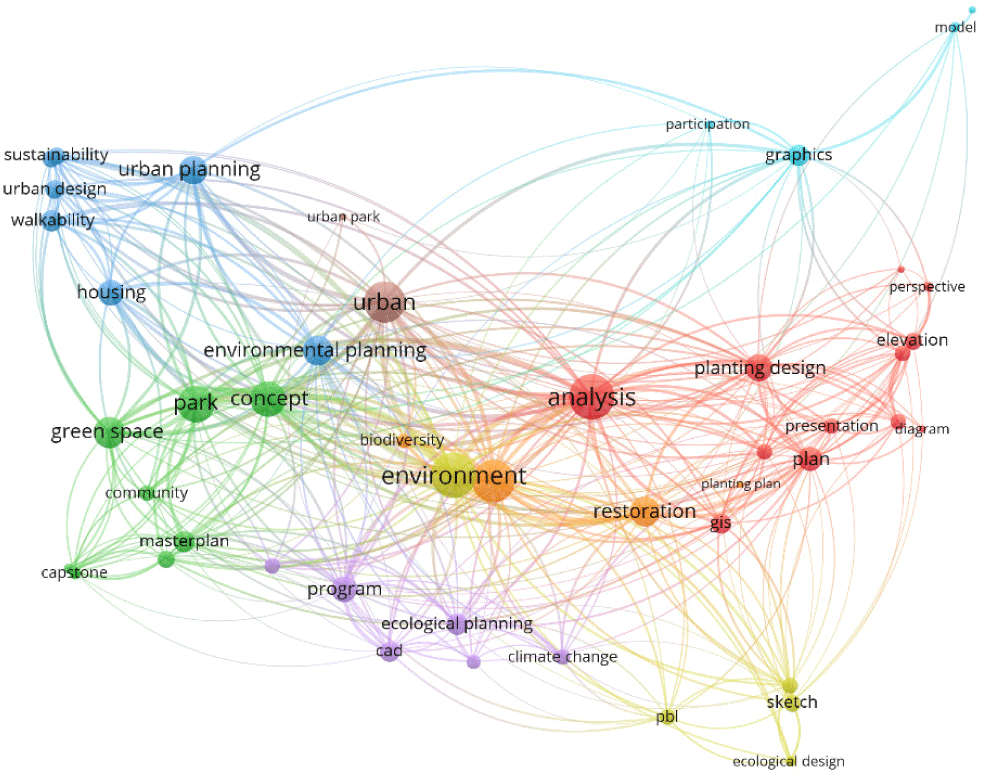
In particular, environment and analysis appeared as axes connecting multiple keywords at the center of the network. Analysis was connected to plan, diagram, GIS, and related terms, indicating a structure in which the analytical process is addressed together with planning and visualization rather than separately from them. Environment was also connected to ecology, urban, and park, confirming that environmental concepts are not limited to ecological topics but are organized within the broader context of urban space and park/green-space design.
At the periphery of the network, keywords related to design representation and visualization, such as graphics, CAD, model, and sketch, were distributed. Although these keywords showed relatively limited connective structures compared with the central keywords, they were connected to diagram, presentation, and plan, suggesting characteristics related to the process of representing and communicating design content. Thus, the network of design courses can be interpreted as a structure in which the design content of urban and green spaces is connected around environment/ecology and analysis, while representational and visualization elements are positioned as processes that concretize this content.
The keyword network of design courses consisted of eight clusters. The major clusters were classified into content related to analytical and planning processes, urban environments, parks and green space, ecology and environment, and design representation and visualization. The cluster centered on analysis was connected to design, plan, diagram, GIS, and related terms, showing that analysis in design courses does not remain an independent survey process but extends into planning and visualization. In particular, the co-occurrence of diagram and GIS with analysis indicates that site interpretation and the representation of analytical results are addressed together within the design process. This suggests that analysis in design courses is not merely a stage of collecting site information, but functions as a mediating process for constructing design concepts and spatial plans.
Clusters centered on urban, park, environment, and ecology were connected to keywords related to urban space, parks and green space, and ecological restoration. Urban was connected to urban planning, urban design, sustainability, and walkability, indicating a tendency to address urban environments and patterns of use together. Park was connected to green space, concept, and community, suggesting that parks and green spaces are addressed in the context of urban environments and publicness. Environment and ecology were connected to restoration, biodiversity, ecological planning, and related terms, while also forming broad links with other clusters. This shows that environment- and ecology-related content is not isolated within a specific thematic group, but plays a role in connecting analysis, urban issues, green space, and planning across design courses. Meanwhile, keywords related to representation and visualization, such as graphics, CAD, model, and SketchUp, formed small clusters at the periphery of the network and were associated with the process of visually representing and communicating design outcomes. However, considering that these keywords were connected to diagram, presentation, and plan, representational and visualization elements can also be understood not simply as design outputs, but as auxiliary processes that concretize analytical and planning content.
The keyword network of studio courses consisted of 49 keywords and 377 links. In terms of TLS, environment showed the highest value, followed by park, analysis, ecology, and urban (Table 6). The overall network structure showed that keywords related to analysis, project implementation, parks and green space, and representation were broadly connected around environment (Fig. 3).
| Rank | Keyword | Total link strength |
|---|---|---|
| 1 | Environment | 389 |
| 2 | Park | 322 |
| 3 | Analysis | 294 |
| 4 | Ecology | 279 |
| 5 | Urban | 267 |
| 6 | Studio | 243 |
| 7 | Capstone | 188 |
| 8 | Restoration | 172 |
| 9 | Program | 142 |
| 10 | Green space | 136 |
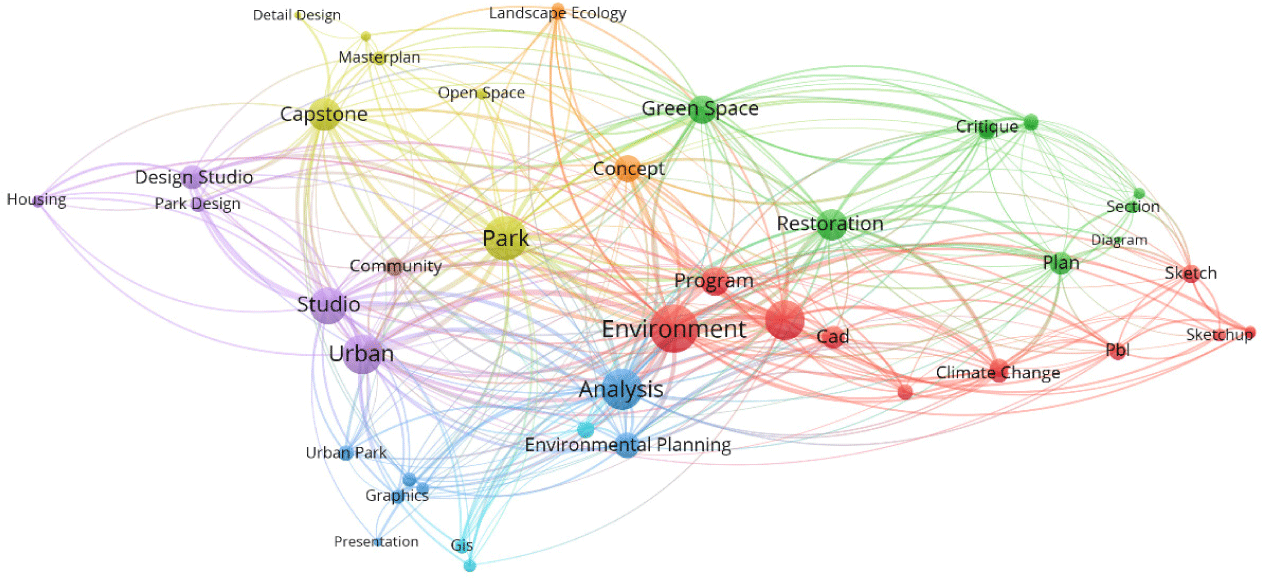
In particular, the network expanded in several directions around the central keywords environment, analysis, and park. On one side, keywords such as urban, studio, capstone, and masterplan were connected, forming a flow of project implementation and spatial planning. On the other side, keywords such as plan, sketch, SketchUp, section, and diagram extended toward design representation and the concretization of outcomes. Analysis was also connected to environmental planning, graphics, and presentation, indicating a flow in which analytical results proceed into visualization and presentation.
Therefore, the studio-course network can be interpreted as a structure centered on environment/ecology and analysis, with their outcomes extending into project implementation, spatial planning, representation, and feedback processes.
The keyword network of studio courses consisted of eight clusters, each formed around different characteristics such as project implementation processes, urban and park design, ecology and environment, design representation and visualization, and feedback and interaction processes. The cluster centered on environment and ecology was connected to program, site analysis, climate change, and related terms, showing that ecological and environmental content is addressed within actual project-based design processes. In particular, the co-occurrence of program and site analysis with environment and ecology reveals a structure in which the interpretation of environmental and ecological conditions leads to program setting and site analysis.
The cluster centered on analysis consisted of keywords such as environmental planning, graphics, and presentation. In this cluster, analytical processes and design-representation keywords formed close relationships, and the process of visually representing analytical results and developing them into project outcomes appeared together. This shows that analysis in studio courses does not remain a preliminary survey stage, but has a performative character connected to the production of outcomes and presentation.
Clusters centered on urban and park reveal the spatial objects and implementation modes of actual design projects. Urban was connected to urban regeneration, housing, design studio, and related terms, indicating that urban regeneration and public space are addressed together within studio projects. Park was connected to capstone, masterplan, and open space, showing a tendency for parks and open spaces to be addressed within comprehensive design and master-planning processes. Meanwhile, keywords such as presentation, graphics, critique, and PBL formed clusters related to representation, presentation, critique, and PBL. This indicates that studio courses have an interactive instructional structure in which design proposals are developed not only by translating analysis and planning into outcomes, but also through presentation and feedback.
The integrated keyword network of design and studio courses consisted of 61 keywords and 556 links. In terms of TLS, environment showed the highest value, followed by analysis, ecology, urban, and park (Table 7). The overall structure of the integrated network showed that keywords related to urban space, parks and green space, project implementation, representation, and feedback were connected around environment and analysis (Fig. 4). This demonstrates that environmental content and analytical processes form common connective axes across design and studio courses.
| Rank | Keyword | Total link strength |
|---|---|---|
| 1 | Environment | 865 |
| 2 | Analysis | 760 |
| 3 | Ecology | 683 |
| 4 | Urban | 661 |
| 5 | Park | 635 |
| 6 | Concept | 409 |
| 7 | Restoration | 372 |
| 8 | Green space | 366 |
| 9 | Environmental planning | 330 |
| 10 | Studio | 314 |
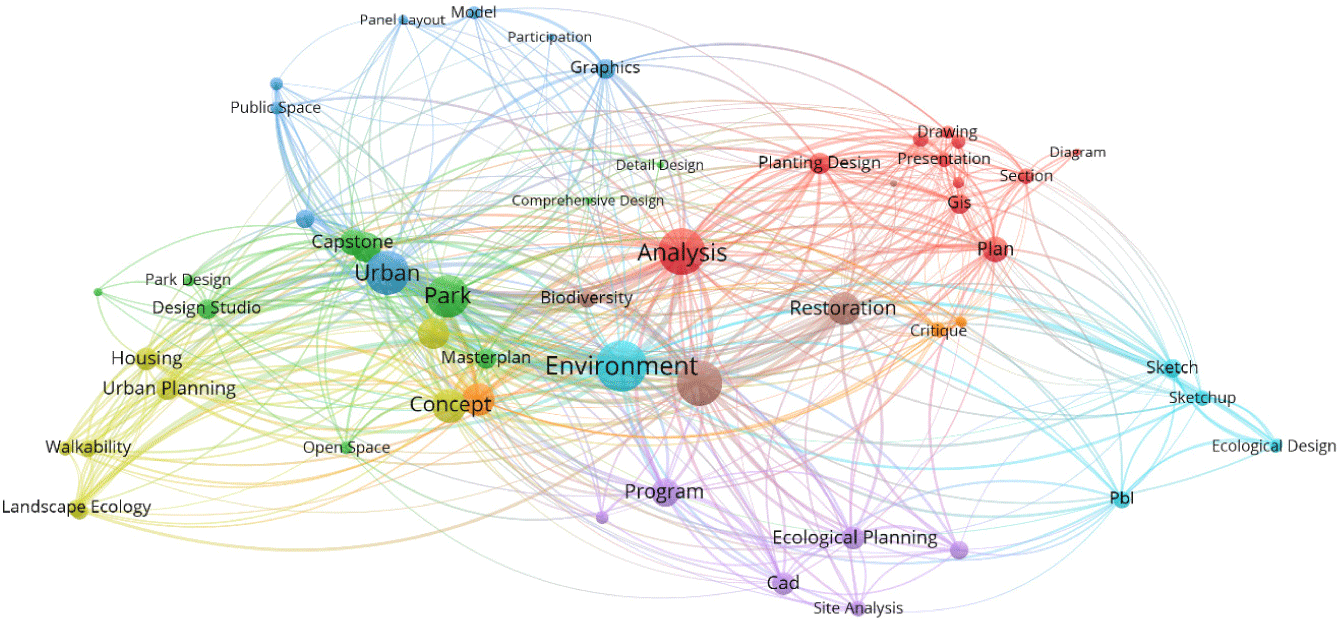
In the integrated network, characteristics identified in both design courses and studio courses appeared together. Keywords such as urban planning, sustainability, walkability, and landscape ecology formed areas related to urban and environmental concepts, connecting to the characteristics of spatial concepts, environmental structures, and analysis-centered content observed in design courses. By contrast, keywords such as design studio, capstone, critique, presentation, and PBL appeared as an area related to the operational processes of studio instruction, including project implementation, presentation, and feedback. This structure indicates that the concept- and analysis-oriented characteristics of design courses and the project implementation-oriented characteristics of studio courses are both reflected within the integrated network.
Analysis was connected to keywords such as plan, GIS, presentation, and program, showing that analytical processes are addressed together with planning, representation, presentation, and project implementation. Environment was also broadly connected to park, urban, program, ecology, and related terms, confirming that environmental concepts appear across design and studio courses rather than being limited to a particular course type or topic. This demonstrates that, in the integrated network, environment/ecology and analysis play central roles in connecting the major educational elements of landscape design education. Keywords related to design representation and visualization, such as sketch, SketchUp, rendering, and graphics, were distributed at the network periphery, but their connections to presentation, diagram, plan, critique, and PBL show that representation, presentation, and feedback processes are also linked to project implementation within the integrated network.
In summary, the integrated network showed that the concept-, analysis-, and planning-oriented structure of design courses and the project implementation-, representation-, and feedback-oriented structure of studio courses are connected around environment and analysis. This indicates that the integrated network is not merely the sum of the two course types, but rather demonstrates that environment/ecology and analysis operate as shared axes connecting multiple educational elements across landscape design education. While design and studio courses have distinct educational emphases, they together form a continuous educational structure that proceeds from the interpretation of environmental conditions to spatial planning, design application, representation, and critique.
A comparison of the design-course, studio-course, and integrated networks showed that environment, ecology, analysis, urban, and park appeared as central keywords with high connectivity across all three networks (Table 8). This indicates that content related to environment and ecology, analysis, urban space, and parks and green space is not limited to a specific course type, but constitutes major educational elements commonly addressed across landscape design education in South Korea.
The differences among the three networks become clear not in the list of central keywords, but in the educational processes with which each keyword is associated. In design courses, environment/ecology and analysis were connected to spatial concepts, urban and green-space planning, and visualization processes. In studio courses, by contrast, similar central keywords appeared together with project implementation, presentation, critique, and the production of outcomes. Even when the same keywords appeared repeatedly, they functioned as criteria for interpretation and planning in design courses, whereas they served as the basis for developing and concretizing projects in studio courses.
The integrated network shows these differences connected within a single relational network. The concept, analysis, and planning elements prominent in design courses and the project implementation, representation, and critique elements prominent in studio courses were linked within the integrated network around environment and analysis. Therefore, the significance of the integrated network analysis lies not merely in reconfirming the characteristics of individual course types, but in showing which keywords mediate the connection between the analytical and planning elements of design courses and the project implementation elements of studio courses.
Design courses are generally understood as domains that address concepts, analysis, and planning, while studio courses are understood as domains responsible for project implementation and the production of outcomes. However, the network analysis in this study showed that the two course types do not operate solely as separate structures. Environment and analysis emerged as common axes connecting spatial interpretation in design courses and project implementation in studio courses, confirming that landscape design education forms a continuous educational structure proceeding from the interpretation of environmental conditions to spatial planning, design application, representation, and critique.
To examine how curriculum keywords intersect with actual landscape design tasks, this study reviewed domestic landscape design competition briefs as supplementary materials. This comparison was not a quantitative analysis conducted in the same manner as the preceding VOSviewer-based co-occurrence network analysis; rather, it was a supplementary review that organized major keywords around the themes, competition purposes, design directions, site conditions, task contents, and evaluation criteria presented in the briefs. Administrative information such as submission schedules, eligibility, submission formats, and awards was excluded.
The analysis covered nine competition briefs from 2024 to 2026 for the Korea Landscape Architecture Competition, the Korea Engineering Consultants Corp. Landscape and Leisure Division Idea Competition, and the Korea Urban Forest Design Competition. These competitions were used as supplementary comparative materials because they make it possible to examine thematic trends across landscape design, practical conditions including real sites and feasibility, and public green-space policy and citizen-use conditions centered on urban forests.
The supplementary comparison showed that keywords appearing centrally in the curriculum network, such as environment, ecology, urban, park, green space, planning, analysis, and site, were also repeatedly identified in the competition briefs (Table 9). This indicates that content related to environment and ecology, urban space, parks and green space, and planning and analysis in landscape design education in South Korea has a certain degree of contact with actual landscape design tasks. However, even when the same keywords appeared, their roles differed between the two sets of materials. In the curriculum data, analysis, GIS, diagram, and presentation were related to site interpretation, the construction of design concepts, and the learning of representational methods. In the competition briefs, by contrast, site, planning, feasibility, and publicness appeared as task conditions requiring the interpretation of actual site conditions and the presentation of the validity and public significance of design proposals.
This difference arises from the distinct characteristics of curriculum materials and competition briefs. Curriculum materials show which analytical tools, representational methods, and studio implementation processes students learn, and therefore keywords such as studio, presentation, critique, GIS, diagram, capstone, and graphics were relatively prominent. By contrast, competition briefs present external tasks that landscape design must address, and therefore emphasize keywords such as publicness, citizen participation, technology, feasibility, engineering, health, management, policy/institution, and carbon neutrality. This means that competition briefs more directly present the social, technical, and site-specific conditions of actual design tasks, including publicness, citizen use, technological change, feasibility, management, policy and institutional frameworks, and climate response.
Therefore, the supplementary comparison with competition briefs can be used as evidence that the results of this study’s course analysis are not limited to the internal keyword structure of the curriculum, but are also connected to environmental, urban, publicness-related, and technological themes required in actual landscape design tasks. At the same time, differences exist between the analysis, representation, and studio implementation elements emphasized in curricula and the publicness, feasibility, management, and policy conditions emphasized in competition briefs. These differences suggest that future landscape design education needs to address not only analytical and representational competencies, but also the public requirements and implementation conditions of real sites more explicitly within the design process.
Discussion
In the results of this study, environment and ecology appeared as central keywords with high connectivity across the design-course network, studio-course network, and integrated network. The meaning of this result is not simply that environment- and ecology-related keywords appeared frequently. What is important is that environment was located at the center together with analysis. This indicates that the way environment and ecology are addressed in recent landscape design education is expanding beyond conceptual understanding or theoretical explanation toward analyzing actual phenomena and translating the results into design judgment. Thus, environment is not treated merely as a background to design, but becomes an object of analysis that must be examined in order to identify site problems and establish design directions.
This trajectory also aligns with the importance of evidence-based design in landscape design education. Environmental issues involve complex conditions that cannot be explained by theoretical concepts alone. Problems such as the urban thermal environment, green-space accessibility, ecological connectivity, and patterns of use provide clearer grounds for design judgment when their causes and effects are examined through actual data and analysis. Because evidence-based landscape design is an approach in which designers interpret evidence about sites, users, and environmental conditions and incorporate it into the design process, it does not regard analysis and design as separate processes (Brown & Corry, 2020). In this context, the fact that analysis appeared as a central keyword across design and studio courses shows that analysis is treated in landscape design education as a process that forms the basis for design judgment. Analysis should be understood not merely as describing site phenomena, but as a process that supports the logic and expected effects of design proposals.
Future landscape design education should not stop at expanding environment- and ecology-related content, but should also address the capacity to analyze environmental phenomena and translate them into design strategies. In this regard, GIS, spatial analysis, data visualization, digital modeling, and AI-based design-support tools cannot be treated simply as objects of technical skill acquisition. Recent studies have discussed the need to integrate digital analytical and representational tools with design-based learning in landscape design education, while generative AI also reveals both new possibilities and limitations within the design process (Fricker et al., 2023; Hsu & Ou, 2022; Zwangsleitner et al., 2024). In particular, AI-based image generation and text-to-image tools can be used for early idea exploration, visual-material generation, alternative comparison, and representation, but their outputs do not directly replace design judgment (Kim & Lee, 2024; Zwangsleitner et al., 2024). For these tools to have meaning in actual curricula, their connection to design problems is more important than learning how to use them. If digital analysis and AI-based representation are separated from site interpretation or design strategy, students will find it difficult to use analytical results and generated images as evidence for design judgment. Therefore, the foundational stage should address the basic principles of GIS and spatial analysis, data interpretation, and visualization, while the studio stage should organize these tools for use in reading actual site problems and establishing design directions. AI-based image generation, automated spatial analysis, and data-based simulation can also have practical meaning within landscape design education when they are treated not as separate technical instruction, but as tools that support analysis, representation, alternative review, and feedback processes.
Design courses and studio courses share common keywords but play different roles within the curriculum. Design courses were shown to have strengths in forming the foundational framework for understanding and analyzing space and environment. In this process, students learn ways of reading and interpreting design objects through urban structures, parks and green space, environmental conditions, and analytical methods. Studio courses, by contrast, play the role of applying and developing these concepts and analyses within actual project processes. Presentation, critique, feedback, and representation can be understood as processes through which analysis and concepts are concretized into design proposals within the studio.
The important point is that the difference between the two course types should not lead to separation. The integrated network, in which the characteristics of design and studio courses appeared together, shows that analysis, environment, urban issues, green space, representation, and project implementation are not separate educational elements, but function in relation to one another across the curriculum. In particular, when the analytical thinking and environmental and urban concepts formed in design courses are connected to project implementation, representation, and feedback processes in studio courses, curricular continuity can be strengthened. Therefore, the relationship between design courses and studio courses can be interpreted not simply as a difference between course types, but as an educational process that proceeds from analysis and concept formation to project application and representation.
This linkage needs to be concretized across year-level stages. At the foundational stage, students can learn environmental and ecological concepts, principles of spatial organization, site reading, and the basic principles of representation and digital tools. At the intermediate stage, these can be extended to the interpretation of urban and green spaces, the establishment of planning concepts, and the derivation of design strategies. In upper-level studios, curricula need to be organized so that analytical results are addressed iteratively within design alternatives, programs, representation, presentation, and critique processes on the basis of the complex conditions of actual sites. When such staged linkage is established, the analysis and concepts developed in design courses can lead into project implementation in studios, while representation and feedback in studios can in turn function as processes that concretize design judgment.
The supplementary comparison with competition briefs shows that the keyword structure of landscape design education is not completely separate from actual landscape design tasks. However, unlike curriculum materials, competition briefs more directly presented conditions such as publicness, citizen use, feasibility, management, policy and institutional frameworks, and climate response. This difference is connected not only to the question of what the curriculum teaches, but also to the question of the criteria by which students should explain and persuade others regarding their design proposals.
Therefore, landscape design education needs to move beyond cultivating analytical and representational competencies and address the public demands and implementation conditions of actual sites within the design process. Even when site analysis and concept formulation are conducted in studio courses, design proposals can remain conceptual if they are not connected to user needs, management feasibility, policy conditions, and practical feasibility. Actual landscape design tasks require not only design creativity, but also explanations of why a space is needed, whom it will benefit and how, and how it can be managed after construction. When these conditions are addressed explicitly within the curriculum, students can use analytical results not only to generate the form or representation of a design proposal, but also as evidence for explaining the validity and expected effects of the design.
To this end, studio education can partially incorporate conditions similar to those found in actual competition briefs or field-based assignments. For example, rather than moving directly from site analysis to the presentation of a design concept, curricula should be organized so that students also examine user needs, project objectives, management entities, budgets and constructability, and relevant policy conditions. In the evaluation of final outcomes, it is also necessary to assess not only formal completeness or representational quality, but also how analytical results are translated into design strategies and how proposed spaces respond to public demands and operational conditions. When the conditions of actual landscape design tasks are incorporated into the curriculum in stages, landscape design education can expand beyond internal training in analysis and representation toward cultivating practical judgment and design logic.
This study is significant in that it analyzed the keyword structure of landscape design education in South Korea on the basis of syllabi and course descriptions, but it has several limitations due to the nature of the data. Syllabi and course descriptions are useful materials for identifying course objectives and major content, but they do not fully reveal instructors’ explanatory methods in actual classes, feedback between students and instructors, the process of developing design proposals, or qualitative differences in final outcomes. In addition, because the formats in which universities provided materials differed, there were limitations in comparing year level, required/elective status, and the ratio of theory to practice using consistent criteria. Therefore, the results of this study should be understood as identifying the structure and tendencies of educational content appearing in publicly available course materials, rather than as explaining the entirety of actual course operations.
Keyword network analysis can be affected by the terminology and expressions used in syllabi and course descriptions, as well as by preprocessing and integration criteria. This study sought to ensure analytical consistency by applying criteria such as synonym integration, English translation of Korean keywords, and exclusion of general information, but some connective structures may vary depending on how keywords are merged. In addition, the supplementary comparison with competition briefs was a complementary review intended to examine how curriculum keywords intersect with actual landscape design tasks, and it was not a quantitative comparison at the same level as the VOSviewer-based co-occurrence analysis. Future studies should analyze actual studio class cases, student design outcomes, and interviews with instructors and students, and should expand comparisons with practical texts such as changes in curricula over time, international landscape design education, and project descriptions from design offices.
Conclusion
This study collected syllabi and course descriptions for design and studio courses offered by landscape architecture departments in South Korea in the 2025 academic year and analyzed the structure and educational tendencies of landscape design education through VOSviewer-based keyword network analysis.
The results showed that environment, ecology, and analysis appeared as central keywords with high connectivity across design courses, studio courses, and the integrated network. The analysis- and planning-oriented structure of design courses and the project implementation- and representation-oriented structure of studio courses were connected in the integrated network around environment and analysis. This indicates that environment/ecology and analysis do not function merely as partial topics in individual courses, but as a shared foundation connecting site interpretation, design concept formation, project implementation, and representation processes in landscape design education. The supplementary comparison with competition briefs also showed that major curriculum keywords have a certain degree of contact with actual landscape design tasks, while competition briefs more directly reveal conditions such as publicness, citizen use, feasibility, management, and policy and institutional frameworks.
The significance of this study lies in identifying the structure of landscape design education in South Korea through a relational network among keywords rather than through individual course cases. The results show that environment/ecology and analysis are not separate educational elements in landscape design education, but operate as a foundation connecting site interpretation and design judgment. Therefore, future landscape design education should not merely treat environment- and ecology-related content as a single thematic area; it should be organized as a process of analyzing actual spatial phenomena and translating the results into design strategies.
In this regard, this study proposes three directions for landscape design education. First, GIS, spatial analysis, data visualization, and AI-based design-support tools should be used within the process of reading site problems and establishing design directions rather than remaining as independent technical skill acquisition. Second, design courses and studio courses should not be treated as separate domains of theory and practice, but should be organized as a staged educational process that proceeds from analysis and concept formation to project application and representation. Third, by addressing more explicitly within studio courses the publicness, citizen use, feasibility, management, and policy conditions required in actual landscape design tasks, students should be enabled to explain not only the form of a design proposal but also its validity and expected effects. In addition, because the keyword network approach used in this study makes it possible to identify relationships among educational elements and differences by course type rather than merely listing individual course content, it can be extended beyond landscape education to curriculum analysis in other design-education fields such as urban planning, architecture, and environmental design.
Nevertheless, because this study analyzed publicly available syllabi and course descriptions, it has limitations in fully explaining actual classroom operations, feedback between instructors and students, and qualitative differences in student design outcomes. Future studies should analyze actual studio class cases, lecture materials, student outcomes, and interviews with instructors and students together, and should expand comparisons with international landscape design education and practice-related texts in order to examine more specifically how the curricular structure of landscape design education is translated into actual classroom processes and the implementation of design assignments.