

Introduction
Offshore wind power has emerged as a central pillar of clean energy in the global transition towards carbon neutrality. Global installed offshore wind capacity stood at approximately 83 GW in 2024 and is projected to nearly triple to 238 GW by 2030 (Bilgili et al., 2023). Large-scale offshore wind development is accelerating not only in Europe but also across East Asia, and the South Korean government has designated offshore wind as a key energy source in its 2050 carbon neutrality roadmap, advancing large-scale development plans across national waters. Jeju Island, in particular, has attracted attention as a leading development site owing to its superior offshore wind resources with an annual average wind speed exceeding 7 m/s (Kim et al., 2016), and multiple facilities — including the Tamra Offshore Wind Farm (30 MW) — are already operational or in the planning stage.
Offshore wind turbines have undergone rapid upscaling driven by technological advancement. The average hub height of offshore wind turbines installed in Europe increased from approximately 88.6 m in 2020 to over 150 m for the latest commercial turbines, with rotor diameters exceeding 162 m over the same period (Bilgili et al., 2023). This turbine upscaling combined with near-shore siting is structurally altering the visual quality of marine landscapes and generating conflicts with the landscape amenity rights of local residents, tourists, and fishery workers (Ladenburg, 2009). Prior studies have consistently confirmed that the visual impact of offshore wind turbines is the most frequently cited reason for opposition even among respondents who broadly support renewable energy development (Kirchhoff et al., 2022).
The visual impact of offshore wind turbines has been identified as a key factor degrading the aesthetic quality of landscapes experienced by users of nearby residential areas, coastal parks, and tourist attractions, thereby weakening community social acceptance (Ladenburg, 2009; Mirasgedis et al., 2014). Given that community opposition driven by landscape impacts can lead to delays or cancellations of renewable energy projects, landscape value assessment has emerged as a core prerequisite for securing the social legitimacy of such projects (Kim et al., 2020). This is particularly urgent in areas such as Jeju Island — designated as a UNESCO World Natural Heritage Site and Biosphere Reserve — where the value of landscape resources is directly linked to tourism and the local economy (Kim et al., 2016).
Research on landscape value assessment of offshore wind farms has developed along two broad streams. The first comprises expert-driven landscape quality assessment methodologies, centred on professionals in landscape architecture, urban planning, and environmental assessment. Representative approaches include Landscape and Visual Impact Assessment (LVIA), landscape sensitivity analysis, zone of theoretical visibility (ZTV) analysis, and scenic beauty estimation (SBE) (Barwicka et al., 2026; Guan, 2022; Sullivan, 2021), all of which seek to quantify landscape impacts by combining expert judgement with GIS-based spatial analysis. The second stream encompasses non-market economic valuation methods grounded in environmental economics. A growing body of research has used contingent valuation method (CVM) and choice experiment (CE) to monetise the external costs of offshore wind landscapes in order to support policy decision-making (Einarsdóttir et al., 2019; Ladenburg & Dubgaard, 2007; Mariel et al., 2015; Mirasgedis et al., 2014).
Research that seeks to bridge these two approaches — or to integrate and compare expert landscape quality assessments with citizen economic valuations — remains extremely limited internationally (Codemo et al., 2024). Landscape visual assessments are known to be influenced not only by aesthetic judgements but also by implicit moral evaluations (Kirchhoff et al., 2022), and respondents’ attitudes and prior experience have been shown to significantly affect willingness to pay (WTP) expressions (Mariel et al., 2015). Because landscape value perceptions are thus constructed differently according to individual and cultural contexts, whether locations evaluated by experts as having ‘high landscape sensitivity’ or ‘severe visual impact’ necessarily elicit higher WTP among citizens remains an empirically unresolved research gap. Furthermore, how this relationship varies in regions with historically and culturally distinctive landscape identities — such as Jeju Island — requires separate context-specific investigation (Kim et al., 2019a).
Drawing on these concerns, this study aims to build a theoretical and methodological foundation for integrated landscape value assessment research targeting the Jeju offshore wind development context through systematic literature review. The specific objectives are as follows. First, to review international trends and methodological characteristics of LVIA for offshore wind farms. Second, to analyse the major findings, quantitative estimates, and methodological limitations of economic non-market valuation studies of offshore wind landscapes (Einarsdóttir et al., 2019; Ladenburg & Dubgaard, 2007; Mirasgedis et al., 2014). Third, to discuss the feasibility of integrating expert landscape quality assessment with citizen economic valuation and identify methodological bridges between the two (Codemo et al., 2024; Mariel et al., 2015). Fourth, to propose research directions and priorities for offshore wind landscape value studies in the Korean and East Asian contexts (Kim et al., 2016, 2020).
Research methods
This study adopted a systematic literature review methodology following the Preferred Reporting Items for Systematic Reviews and Meta-Analyses (PRISMA) guidelines. PRISMA constitutes an internationally recognised standard for ensuring the transparency of search strategies, the explicitness of selection criteria, and the reproducibility of screening procedures in systematic reviews. The literature search was conducted in October 2024 using two major academic databases: Web of Science (Core Collection) and Scopus. The search period was set from 2000 to 2024, encompassing the period from which commercial offshore wind development became established — marked by the commissioning of the Horns Rev wind farm in Denmark in 2002 — through to the present landscape of international scholarly debate.
Search terms were organised into three thematic clusters and combined using Boolean operators. Cluster 1 (research target) comprised ‘offshore wind farm’, ‘offshore wind turbine’, and ‘offshore wind energy’. Cluster 2 (landscape assessment methodology) included ‘landscape visual impact’, ‘landscape quality assessment’, ‘scenic beauty’, ‘seascape assessment’, ‘LVIA’, ‘ZTV’, and ‘viewshed’. Cluster 3 (economic valuation) included ‘willingness to pay’, ‘contingent valuation’, ‘choice experiment’, ‘non-market valuation’, ‘visual disamenity’, and ‘hedonic pricing’. The actual search was executed in the form of (Cluster 1) AND (Cluster 2 OR Cluster 3), with a supplementary search combining ‘Korea OR Jeju’ to capture studies in the Korean and Jeju Island contexts. Searches were conducted across title, abstract, and keyword fields.
Retrieved papers were screened in two stages according to the following explicit inclusion and exclusion criteria. In Stage 1, two independent reviewers screened titles and abstracts to exclude papers clearly lacking relevance, with disagreements resolved through consensus review. In Stage 2, full texts were reviewed to determine final eligibility (Table 1).
The initial database search identified 74 records from Web of Science (Core Collection) and 81 from Scopus, yielding a total of 155 records. After deduplication, 128 records remained. Stage 1 title and abstract screening excluded 72 papers irrelevant to landscape assessment or economic valuation: 31 energy systems engineering papers, 24 environmental and ecological impact papers, and 17 policy and economic analysis papers. Stage 2 full-text review examined 56 papers, from which a further 18 were excluded: 9 for unspecified methodology, 6 as purely technical papers, and 3 due to inaccessible full text. A final total of 38 papers were selected for in-depth analysis, and the most relevant representative works among these are reviewed in detail in the body of this article (Fig. 1).
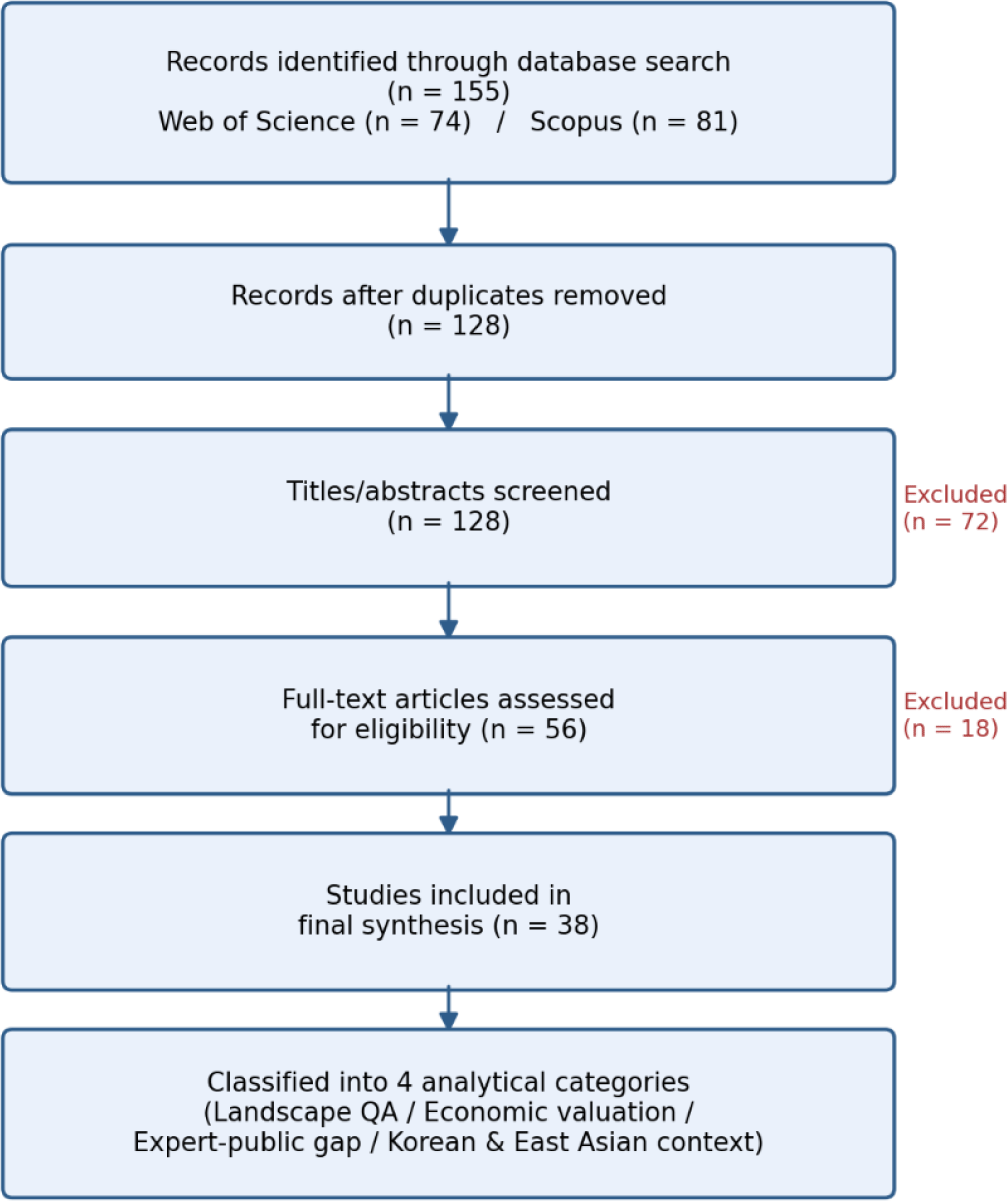
The 38 selected papers were classified into four analytical categories for review. Classification was based on each study’s primary methodology and core research question; where a paper contributed to multiple categories, it was classified according to its principal contribution with secondary categories noted. For each category, content analysis was conducted across four dimensions: (1) methodological approach and core procedures, (2) major findings and quantitative estimates, (3) methodological strengths and limitations, and (4) implications for future research and policy. A full list of the 38 selected studies, including author, country/study region, methodology, sample size, and key findings, is provided in Appendix A (Table A1) to ensure the transparency and reproducibility of the review (Table 2).
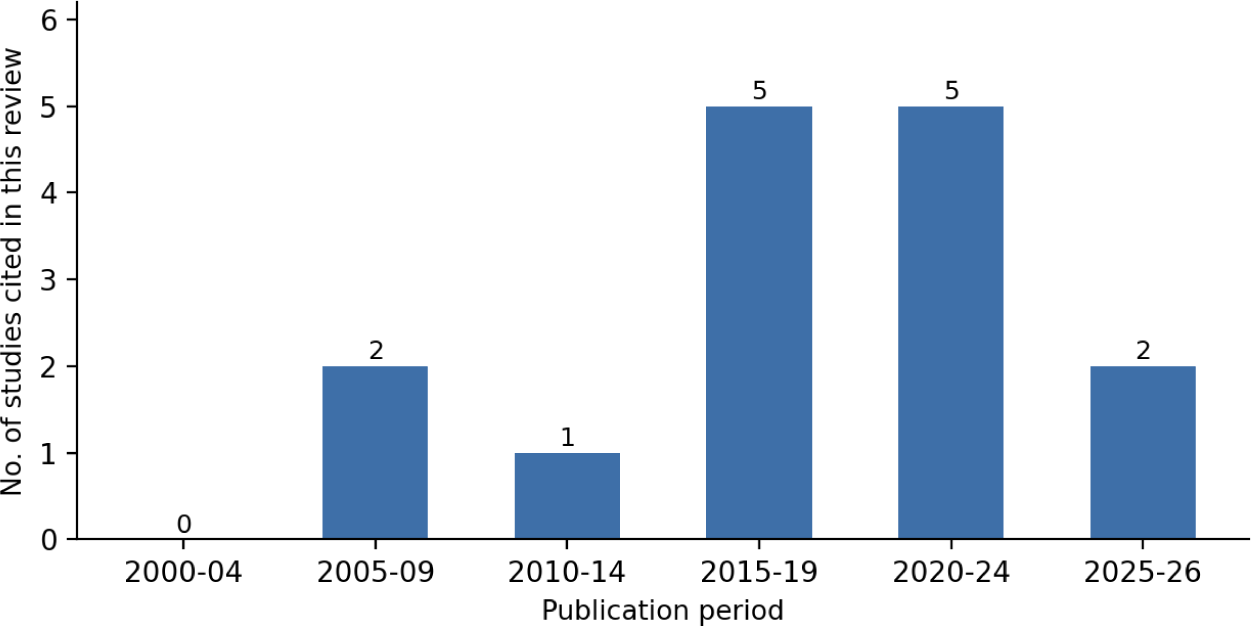
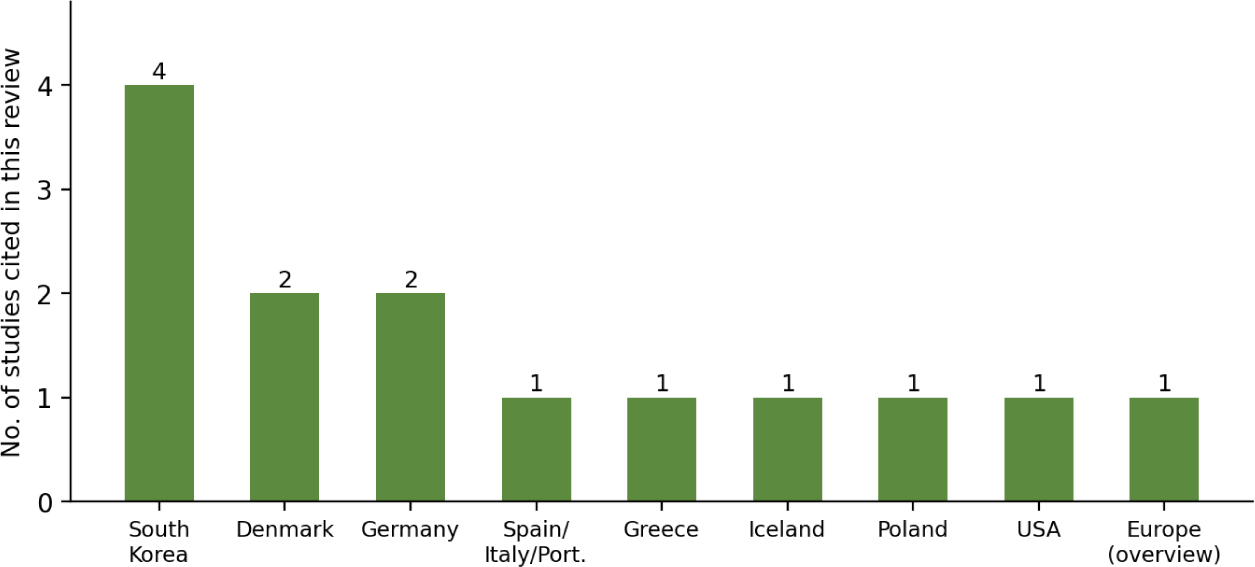
To complement the categorical classification above, the temporal and geographic distribution of the reviewed studies was additionally examined. As shown in Fig. 2, the proportion of studies employing CE and CVM designs has increased markedly since 2015, broadly coinciding with the accelerated scale-up of European offshore wind capacity. Geographically (Fig. 3), the literature discussed in this review remains heavily concentrated in Northern and Southern Europe, while studies addressing the Korean offshore wind context account for a comparatively small but growing share — underscoring the regional research gap that this study seeks to address. A corresponding breakdown for the full set of 38 selected papers is reported in Appendix A.
The methodological rigour of selected papers was assessed using criteria appropriate for quantitative and qualitative studies respectively. For quantitative studies (CVM, CE, and statistical analysis-based research), the following were examined: adequacy of sample size and representativeness, approaches to ensuring validity and reliability of measurement instruments, methods for handling protest responses and bias, and external validity of findings. For qualitative and expert assessment studies (LVIA and SBE-based research), assessment covered: transparency and reproducibility of evaluation procedures, criteria for appraiser selection and level of expertise, accuracy of visualisation tools (photomontage, GIS outputs), and appropriateness of contextual interpretation of findings. This process enabled a balanced understanding of each study’s strengths and limitations, and ensured that methodological biases were considered when interpreting results.
Results
The LVIA of offshore wind farms requires a more complex evaluation framework compared to onshore wind. Offshore turbines may be located beyond the horizon, visibility varies rapidly with sea fog and weather conditions, and multiple observation receptors exist on both the land and sea sides. A methodology report prepared for the U.S. Bureau of Ocean Energy Management (BOEM) presented a comprehensive framework for Seascape, Landscape, and Visual Impact Assessment (SLVIA) of offshore wind developments (Sullivan, 2021). This framework consists of two components — Seascape and Landscape Impact Assessment (SLIA) and Visual Impact Assessment (VIA) — and systematically identifies multiple receptors including coastal residents, visitors, and mariners, distinguishing between daytime and night-time (navigation light illumination) viewing conditions. The report recommends a standardised five-stage procedure to ensure the consistency and defensibility of assessments: scoping, receptor identification, landscape character description, impact prediction, and significance determination (Sullivan, 2021). It now functions as a de facto international reference standard for offshore wind SLVIA.
Among expert-based landscape assessment methodologies, GIS-based quantitative approaches offer particular strengths in reproducibility and objectivity. A study using the Friedrich-Wilhelm Raiffeisen wind farm in Germany as a case study proposed a landscape visual impact evaluation (LVIE) model (Guan, 2022). This model implements a quantitative indicator framework structured around three dimensions — landscape sensitivity, visual impact of wind turbines, and viewer exposure — through GIS multi-criteria decision-making (MCDM) analysis. Landscape sensitivity is calculated as a weighted sum of land use type, degree of naturalness, and landscape conservation value; visual impact is quantified by combining the visible area derived from ZTV analysis with turbine size; and viewer exposure is synthesised from population density, residential points, and key viewpoints (KVPs). While this three-dimensional composite index is useful for rapidly comparing landscape impacts across candidate sites at the project planning stage, it carries limitations including the subjective setting of indicator weights and difficulty in reflecting the actual perceptual experience of the public.
ZTV analysis and photomontage have become core tools in expert assessment. ZTV is a GIS-based technique that uses digital elevation models to calculate the theoretically visible extent of wind turbines, functioning as a primary screening tool in landscape impact assessment. However, ZTV tends to overestimate visibility because it cannot account for factors such as vegetation, buildings, and atmospheric transparency that affect actual visibility in practice; a composite assessment approach combining field photographs and visualised photomontages with ZTV is therefore internationally recommended to address this limitation (Sullivan, 2021).
SBE is an observer-based methodology that collects and analyses the aesthetic evaluations of a general observer group using standardised procedures. Developed by Daniel & Boster (1976), SBE has been widely applied to the assessment of forest landscapes, rural landscapes, and energy infrastructure landscapes. A study applying a modified SBE methodology to assess the impact of wind turbines on the aesthetic quality of Polish rural landscapes used standardised computer-generated visualisations (SketchUp 2026, Lumion rendering) rather than actual site photographs to control for extraneous factors such as lighting, weather, and season — representing a methodological innovation (Barwicka et al., 2026). The evaluation of turbine placement scenarios at setback distances of 500, 750, and 1,000 m across seven rural landscape types in Poland found that shorter setback distances produced significantly lower landscape evaluation scores (ANOVA, p<0.001, η²p=0.062), with the most pronounced negative impacts in large-scale cropland landscapes (Z=−0.886) and the highest aesthetic evaluations in mountain agricultural landscapes (Z=1.20). No significant difference was found between 750 and 1,000 m (p=0.36), confirming a diminishing marginal effect. The study emphasised the need for integration of SBE with GIS/LVIA, though the demographic skew of the sample (76.9% female, 60.6% under 25 years) was noted as a limitation to external validity.
An experimentally innovative study investigated whether visual evaluations of wind turbines constitute judgements of scenic beauty or of moral desirability (Kirchhoff et al., 2022). Comparing aesthetic evaluations of identical wind turbine landscape images between groups of German respondents who supported and opposed wind energy, those with pro-wind attitudes rated the same turbine landscapes significantly higher than opponents (p<0.001). This suggests that visual impact statements are substantially influenced by implicit moral judgements, implying that even expert scenic beauty assessments may not be free from value imposition. The study methodologically indicates that attitude variables must be controlled or measured in any integrated study of landscape quality assessment and economic valuation.
Non-market valuation research aimed at monetising the external costs of offshore wind farm landscapes has accumulated primarily around CVM and CE. CVM is a methodology that directly elicits respondents’ WTP or willingness to accept compensation by constructing a hypothetical market, and is well suited to estimating the total value of a single non-market good.
A pioneering study estimated WTP for the preservation of the Búrfellslundur wind farm landscape in Iceland using CVM (Einarsdóttir et al., 2019). A web-based survey was distributed to 1,700 individuals, yielding 690 valid responses (response rate 40.6%), and WTP was estimated using a double-bounded dichotomous choice format. Results indicated that 28% of respondents expressed a positive WTP for preservation of Búrfellslundur, and the mean WTP — excluding protest respondents — was estimated at approximately 12,549 ISK (roughly USD 128). Extrapolated to the full Icelandic taxpayer population, the economic value of landscape preservation was calculated at approximately USD 32.3 million. The study incorporated pre-survey information provision and certainty questions to mitigate hypothetical bias, though the potential for overestimation of non-use values was noted as a limitation.
A study assessing the economic value of wind farm landscape externalities in the South Evia region of Greece using CVM also systematically compared three non-market valuation methodologies — Hedonic Pricing, CVM, and CE — providing a useful reference framework (Mirasgedis et al., 2014). Based on face-to-face interviews with 498 households, 57% of respondents expressed no willingness to contribute financially to measures mitigating the visual impact of wind farms. The mean WTP among households expressing a positive value was estimated at approximately EUR 41.6 per year — relatively low compared to comparable studies — a finding attributed to reduced disposable income and austerity fatigue during the Greek economic crisis of the early 2010s. Income level, proximity of residence to the wind farm, and membership of environmental organisations were found to have significant positive effects on WTP.
Discrete Choice Experiment (DCE or CE) is a methodology that estimates the marginal WTP for each attribute by having respondents choose their preferred alternative from options defined by multiple attributes. In offshore wind landscape research, CE offers the advantage of simultaneously estimating respondent preferences for diverse attributes such as setback distance, number of turbines, farm scale, and ownership structure.
A pioneering CE study measured WTP for reductions in visual disamenity from future offshore wind farms in Denmark (Ladenburg & Dubgaard, 2007). Using a sample of 355 coastal residents and a CE design incorporating setback distance attributes of 8, 12, 18, and 50 km from the shoreline, all sample groups expressed significant WTP for locating wind farms further from the coast. However, the relationship between setback distance and WTP followed a diminishing marginal returns pattern rather than a simple linear one: the WTP increment from 8 to 12 km was substantially larger than that from 12 to 18 km. Respondents with prior experience of offshore wind farms also tended to express higher WTP for greater setback distances than those without such experience. This diminishing marginal returns pattern in the setback distance–WTP relationship has been replicated in subsequent studies (Mariel et al., 2015) and is considered a robust finding.
A study in the Basque Country of Spain analysed heterogeneous preferences towards landscape externalities of wind turbines using a hybrid choice model (HCM) combining CE with attitudinal data (Mariel et al., 2015). By incorporating respondents’ latent attitudes — support for renewable energy and landscape-oriented disposition — as latent variables integrated into the CE utility function, the study explored the linkage between landscape attitudes and WTP expression beyond simple economic valuation. Results showed that stronger support for renewable energy was associated with lower perceived landscape external costs from wind turbines, while a stronger landscape-oriented disposition was associated with significantly higher WTP. This finding empirically corroborates — in the context of economic valuation — Kirchhoff et al.’s (2022) observation that moral judgements are embedded in landscape visual assessments, and reaffirms the importance of controlling for attitude variables in research designs that integrate expert landscape quality assessment with citizen economic valuation.
In the Korean context, a CE study based on a nationwide sample of 1,026 respondents is noteworthy (Kim et al., 2019b). CE attributes included location type (offshore/onshore/nearshore), ownership structure (national/community/private/foreign capital), electricity utilisation mode (local priority supply/national supply), and annual additional electricity cost per household. The mean WTP per household per month was estimated at approximately KRW 3,600 (roughly USD 3.1), and the aggregate national benefit was calculated at approximately KRW 869 billion per year (roughly USD 744 million). Respondents expressed strong negative preferences for foreign capital ownership, while strongly preferring community-based ownership structures, suggesting that perceptions of energy sovereignty play an important role in shaping social acceptance of offshore wind in South Korea.
The gap between expert and lay public perceptions in landscape value assessment has emerged as a central challenge in landscape governance. Experts evaluate landscape impacts through trained analytical frameworks and standardised procedures, whereas the general public constructs landscape value through personal experience, emotional attachment, and cultural meaning-making. This divergence in judgement systems stems not merely from a knowledge gap but from axiological differences in perspective, necessitating methodological deliberation beyond simple integration of the two approaches.
A mixed-methods study explored public perceptions of photovoltaic energy landscapes in Mediterranean countries (Italy, Spain, Portugal) and sought to integrate these perceptions into local spatial planning tools (Codemo et al., 2024). Using a visual Q-methodology, 21 citizens evaluated 36 photovoltaic landscape photographs, yielding four distinct viewpoint types: (1) landscape damage concern, (2) energy necessity priority, (3) aesthetic integration focus, and (4) indifference. Subsequent in-depth interviews with 10 regional planning experts analysed points of agreement and divergence between expert spatial planning criteria and citizen viewpoint types, resulting in the proposal of integrated landscape strategy guidelines incorporating both perspectives. This study’s significance as a key methodological reference for this review lies in its revelation of the multi-layered nature of public perceptions of renewable energy landscapes and its concrete operationalisation of expert–citizen integration procedures.
A study proposing an offshore wind farm siting strategy for the coastal areas of Jeju Island evaluated feasible candidate sites using a MCDM model based on the analytic hierarchy process (AHP) (Kim et al., 2016). Under four criterion categories — energy resources and economics, protected areas and landscape conservation, human activities, and marine environment and ecology — 21 detailed criteria were assessed through GIS spatial analysis. Results indicated that the north-western waters of Jeju showed the highest siting suitability in terms of economic and environmental performance, while landscape conservation criteria functioned as substantive exclusionary constraints due to the need for buffer distances from UNESCO World Natural Heritage buffer zones and key fishing grounds. The southern and eastern coastal waters of Jeju were rated markedly low in siting suitability owing to conflicts with outstanding coastal landscape resources. This study is significant in demonstrating that landscape value constitutes a core siting constraint of equal weight to energy efficiency in Jeju offshore wind development (Kim et al., 2016).
A study analysing the formation of community acceptance in response to wind turbine installation on Jeju Island from a community engagement perspective found that collective memories of socioeconomic deprivation — including historical traumas of the Japanese colonial period, the Korean War, and the April Third Incident — had shaped the conditions that made community engagement with renewable energy projects meaningful for Jeju residents (Kim et al., 2019a). The study simultaneously captured the tension that this participatory structure could result in selective participation reflecting particular stakeholder agendas. These findings strongly suggest that landscape assessment of Jeju offshore wind should encompass complex social and landscape analysis extending beyond simple visual impact evaluation to include local historical memory, cultural identity, and power relations.
A study analysing public acceptance of a large-scale 2.46 GW offshore wind development plan in South Korea — targeting multiple sea areas including the waters off South Jeolla Province — through a nationwide structured survey of 1,000 respondents found that 43.3% supported the project, 23.8% opposed it, and the remaining 32.9% were neutral (Kim et al., 2020). Among residents in the project vicinity, fishery workers, and older age groups, opposition rates were markedly higher, confirming that spatial proximity and livelihood linkage function as core variables in acceptance. The study reported that landscape impact was spontaneously cited by respondents as one of the primary reasons for opposition, thereby supporting the policy importance of landscape management in large-scale offshore wind development.
Discussion
The findings of this literature review demonstrate the urgent need for integrated research combining expert-based landscape quality assessment and citizen economic valuation in the field of offshore wind farm landscape value assessment. Prior studies have applied expert evaluation tools such as LVIA, ZTV, and SBE (Barwicka et al., 2026; Guan, 2022; Sullivan, 2021) and economic valuation methods such as CVM and CE (Einarsdóttir et al., 2019; Ladenburg & Dubgaard, 2007; Mirasgedis et al., 2014) independently of one another. As a result, whether locations evaluated by experts as having ‘high landscape sensitivity’ also elicit high WTP among citizens — and if not, what accounts for the discrepancy — remains empirically unresolved (Codemo et al., 2024).
The HCM (Mariel et al., 2015) and the Q-methodology-based expert–citizen integration approach (Codemo et al., 2024) offer methodological bridges for connecting the two streams. Specifically, a sequential integration design is feasible in which: (1) expert panel-based landscape quality assessment is first conducted to derive landscape sensitivity and visual impact intensity indicators for the target site (Guan, 2022; Sullivan, 2021); (2) citizen CE is carried out simultaneously at the same site to estimate WTP by setback distance, number of turbines, and landscape type (Kim et al., 2019b; Ladenburg & Dubgaard, 2007); and (3) the correlation and coefficient of determination between landscape quality indicators and WTP estimates are analysed (Codemo et al., 2024; Mariel et al., 2015). In this design, incorporating attitude variables — support for renewable energy and landscape-oriented disposition (Kirchhoff et al., 2022) — as latent variables in the CE would enable control of confounding effects attributable to attitude (Mariel et al., 2015).
The importance of cultural and contextual factors in offshore wind landscape assessment was repeatedly confirmed across the literature reviewed in this study. Landscape visual assessments are known to be deeply influenced by implicit moral judgements beyond purely aesthetic evaluations (Kirchhoff et al., 2022), and respondents’ support for renewable energy has also been shown to significantly affect their level of WTP expression (Mariel et al., 2015). In the case of Jeju Island, wind has long functioned as a core element of local life and folk culture within the island’s cultural identity as ‘Samda-do (三多島)’ — the island of three abundances: wind, stone, and women (Kim et al., 2019a). Such cultural landscape context may yield different outcomes in landscape quality evaluations and WTP expressions for identical turbine sizes and setback distances (Kirchhoff et al., 2022; Mariel et al., 2015), and the influence of cultural familiarity with wind on landscape sensitivity judgements in the Jeju offshore wind context warrants separate investigation.
The spatial overlap of Jeju’s UNESCO World Natural Heritage designated areas and landscape conservation zones with offshore wind development sites raises complex landscape governance questions connected to whether the Outstanding Universal Value (OUV) of the World Heritage site would be compromised — extending beyond simple visual impact assessment (Sullivan, 2021). Landscape conservation criteria have functioned as de facto exclusionary constraints in Jeju offshore wind development (Kim et al., 2016), raising the normative question of what weights quantitative landscape quality indicators and economic WTP estimates should be accorded in policy decision-making (Codemo et al., 2024; Mirasgedis et al., 2014).
It should further be emphasised that Jeju Island holds a distinctive "UNESCO Triple Crown" status — Biosphere Reserve (UNESCO, 2002), World Natural Heritage Site (UNESCO World Heritage Centre, 2007), and Global Geopark (UNESCO, 2010) — each governed by separate designation criteria and management authorities. The spatial overlap of these three protected-landscape regimes with candidate offshore wind sites raises layered governance questions that extend beyond the single OUV-related concern noted above: whether Geopark-designated geomorphological viewpoints (e.g., Seongsan Ilchulbong, Suwolbong) require distinct viewshed protections beyond standard ZTV thresholds, and whether Biosphere Reserve buffer-zone principles — which prioritise the integration of conservation and sustainable use rather than strict exclusion — can be reconciled with industrial-scale energy infrastructure. An integrated assessment framework for Jeju should therefore incorporate designation-specific landscape sensitivity weightings, rather than treating “landscape conservation” as a single undifferentiated siting constraint as in Kim et al.’s (2016) AHP-based model, in order to reflect the distinct legal and cultural significance attached to each UNESCO designation.
The major methodological improvement agenda identified through the literature review is as follows. First, mechanisms for coordinating disagreements within expert groups are needed. Given that landscape quality assessment results may differ among evaluators with backgrounds in landscape architecture, urban planning, and environmental assessment (Guan, 2022; Sullivan, 2021), the use of Delphi methods to facilitate expert consensus can contribute to establishing reliable assessment indicators. Second, standardisation is needed in the treatment of protest responses in CVM and CE. In one prior study, 72% of respondents expressed no WTP (Einarsdóttir et al., 2019), and the criteria for distinguishing between genuine zero WTP and survey method-directed protest differ across studies (Mirasgedis et al., 2014), complicating cross-study comparisons. Third, approaches to mitigating hypothetical bias are required. Because CVM and CE both measure hypothetical willingness to pay, divergence from actual payment behaviour can occur (Einarsdóttir et al., 2019), and the application of techniques such as pre-survey information provision, Cheap Talk scripts, and certainty calibration is recommended (Mirasgedis et al., 2014).
Just as the SLVIA framework has been adopted as a de facto standard procedure in the U.S. BOEM offshore wind permitting process (Sullivan, 2021), the systematisation and standardisation of landscape value assessment is needed in South Korea’s environmental impact assessment and offshore wind siting procedures. In the current Korean offshore wind environmental impact assessment process, landscape impacts are treated comprehensively but specific methodologies such as ZTV analysis, photomontage, and expert panel composition are not stipulated, leaving the consistency and defensibility of assessments unguaranteed (Kim et al., 2016; Sullivan, 2021). If a landscape external cost indicator integrating expert landscape quality assessment results and citizen WTP estimates were incorporated into cost-benefit analysis within environmental impact assessment, the social legitimacy of offshore wind siting decisions would be strengthened (Codemo et al., 2024; Mirasgedis et al., 2014). In regions such as Jeju — where the value of landscape resources is directly linked to the tourism and cultural economy — the monetary estimation of landscape external costs should be a key variable in project feasibility analysis (Einarsdóttir et al., 2019; Mirasgedis et al., 2014), and can serve as a proactive policy instrument for enhancing community acceptance and preventing conflict (Kim et al., 2020).
Conclusion
This study reviewed the international scholarly literature on landscape value assessment of offshore wind farms in the energy transition era through a systematic literature review following PRISMA guidelines. A total of 155 records were collected from Web of Science (Core Collection) and Scopus, and 38 papers were selected for in-depth analysis across four analytical categories — landscape quality assessment methodology, economic valuation, expert–public perception gap, and Korean and East Asian context — following the application of inclusion and exclusion criteria.
The major findings are summarised as follows. First, expert assessment of offshore wind landscapes has developed across diverse methodologies including the SLVIA framework (Sullivan, 2021), the GIS-MCDM-based LVIE model (Guan, 2022), and modified SBE application (Barwicka et al., 2026), but shares common limitations in the absence of cross-methodological standardisation and the difficulty of capturing subjective public experience. Second, economic valuation studies using CVM and CE (Einarsdóttir et al., 2019; Kim et al., 2019a; Ladenburg & Dubgaard, 2007; Mirasgedis et al., 2014) consistently confirmed a diminishing marginal returns relationship between offshore setback distance and WTP, and demonstrated that respondents’ attitudes, income, and prior experience significantly affect WTP. Third, the deep involvement of attitudinal variables in both landscape visual evaluations and WTP expressions was confirmed, and the need for attitude control in integrated research combining the two approaches was methodologically established (Kirchhoff et al., 2022; Mariel et al., 2015). Fourth, the complex interaction of cultural landscape identity and social acceptance with landscape evaluation was demonstrated in the Korean context (Kim et al., 2016, 2019a, 2020).
On the basis of these findings, the following integrated research design is proposed for future studies targeting the Jeju offshore wind development context. An expert panel comprising at least five specialists each in landscape architecture, urban planning, and environmental assessment should be convened to conduct field survey-based landscape quality assessment (LVIA+SBE), while simultaneously administering CE-based WTP measurement to a sample of Jeju residents and visitors (target sample size: at least 500). When analysing the correlation between the two sets of results, renewable energy attitude variables should be incorporated as latent variables in an HCM, and Jeju’s distinctive cultural landscape identity should be specified as a moderating variable, enabling empirical determination of the magnitude and determinants of the gap between expert assessment and citizen valuation.
This study carries the limitation that, as a single-researcher literature review, a degree of subjective judgement was necessarily involved in determining the scope and classification of selected literature. The exclusion of Korean-language publications from the review also means that domestic Korean research outputs — particularly scholarly discussions related to offshore wind in Jeju and the South-West Sea — may not be sufficiently reflected. Notwithstanding these limitations, this study systematically establishes the theoretical and methodological foundations for integrated landscape value assessment research targeting the Jeju offshore wind development context, and is expected to contribute to deepening academic and policy discourse on renewable energy landscape governance.


