

Introduction
The philosophy of Zhuangzi, which serves as the conceptual foundation of this study, centers on Wu-wei (inaction and nature) as its core value and operates within an intertextual context between nature and artifice. Because Zhuangzi’s thought inherently embraces diversity and non-linearity rather than sticking to a linear perspective, conflicting viewpoints often coexist depending on how one interprets the text. Therefore, rather than attempting to encompass the entirety of Zhuangzi’s philosophy, this study focuses specifically on the concept of Wu-wei found in the Inner Chapters, which represents the very essence of his thought. In particular, the philosophical foundations laid out in Xiaoyaoyu (free and easy wandering), Qiwulun (discussion on making all things equal), and Yangshengzhu (the master of nurturing life) constitute the crucial underlying framework for the arguments developed in this research.
Zhuangzi was a Taoist thinker who espoused absolute freedom, the boundaries of artifice, and relative truth within the overarching framework of Wu-wei. Xiaoyaoyu is the section of the Inner Chapters where the context of Wu-wei manifests most vividly; here, Wu-wei can be effectively translated into a state of “freedom” or “self-existence”. As a practical methodology for attaining Wu-wei, Zhuangzi proposed Wu Wo Yi Ti (the unity of subject and object). This principle-which stands for an inherent, pristine state untouched by artificial human agency-was the fundamental reason behind his steadfast refusal of prestigious ministerial positions in the secular world.
In this context, Wu-wei exists in symmetry with Yu-wei (action/artifice). In Buddhism, artificial action is viewed as the root cause of generation, extinction, and change; conversely, the changeless world of truth or the immutable essence of the phenomenal world is referred to as Wu-wei. Concepts such as nirvana, tathata, ultimate reality, and dharmata are all variations of this Buddhist notion of inaction. On the other hand, Zhuangzi’s Wu-wei means allowing the universe to flow, relate, and adjust on its own without any artificial control or intervention. In other words, it reflects the naturalness of the “Tao” (the way), where all things spontaneously harmonize even in the absence of a cosmic director. It denotes a state in which a spirit that has transcended all constraints roams freely in the realm of absolute liberty.
Accordingly, a proper understanding of Wu-wei requires a prior reflection on the concept of ‘Mu’ (nothingness/non-being). In Lao-Zhuang philosophy, ‘Mu’ should be understood not as mere void or deficiency, but rather through the concept of ‘Xu’ (emptiness). This emptiness is not just a physically vacant state; rather, it possesses a dynamic potential akin to “a bellows that is empty yet endlessly pours forth vital energy.” That is to say, ‘Mu’ is not an absence, but a space of potentiality preserved so that things can manifest their proper functions. This nuance becomes clearer when contrasting the English terms “Blank” and “Empty.” While “Blank” evokes a two-dimensional surface where nothing has been recorded, “Empty” describes a three-dimensional space whose interior is vacant, waiting to be filled with new meaning. This difference in imagery creates a profound divergence in depth when interpreting Zhuangzi’s philosophy.
Consequently, the core axis of Zhuangzi’s thought converges into Wu-wei and Wu Wo Yi Ti. The logic dictates that when humans align themselves with the natural order and relinquish artificial greed, a path toward coexistence opens up spontaneously. Because conflicts in human society generally stem from the materialistic desire to possess and demand things from others, emptying one’s desires, acknowledging differences, and achieving harmony with others represents the highest state of being. This train of thought flows consistently through Xiaoyaoyu and Qiwulun, and passes through Yangshengzhu and Renjianshi (In the world of human) to form the overarching core narrative that penetrates the entirety of the ‘Inner Chapters’.
Director Tim Burton has exerted a profound influence on the evolution of the film industry and the creation of new artistic values, building a prolific career driven by a highly idiosyncratic visual aesthetic. Yet, despite his formidable standing, there remains a relative dearth of in-depth scholarly research analyzing his work strictly through the lens of visual aesthetics. This study thus originates from an academic imperative to re-examine and shed new light on Burton’s cinematic universe.
By mapping Taoist thought-a cornerstone of Eastern philosophy-onto the structural framework and directorial background of Burton’s films, this study aims to scrutinize the mise-en-scène through which his singular worldview is projected. Furthermore, grounded in a narratological approach, this research explores the layers of meaning and visual structure within his films. The ultimate goal is to define Burton’s unique mode of visual representation, which successfully constructs a value system distinct from conventional cinematic conventions.
The scope of this research is limited to three specific works directed by Tim Burton: the feature film ‘Alice in Wonderland’, the stop-motion animated feature ‘Corpse Bride’, and the musical thriller ‘Sweeney Todd: The Demon Barber of Fleet Street’. This paper analyzes the sequences and synopses of each work from the perspectives of mise-en-scène and visual design, investigating how Burton’s cinematic world is artistically sublimated when viewed through the prism of Zhuangzi’s core philosophy of ‘Wu-wei’ (inaction and nature).
In doing so, this study identifies the intersections that connect the philosophical context of Zhuangzi with the semantic structures of Burton’s films, examining how fantasy and grotesque imagery manifest in the process of representing meaning. Ultimately, it analyzes how the insights derived from this intersection transition into the relative principles of Taoism, encapsulated by Zhuangzi’s concept of Wu-wei.
Exploring the ideological context of Zhuangzi’s ‘Wu-wei’ (inaction and nature)
Adopting Zhuangzi as the foundational anchor of a study presents a considerable challenge, if not a methodological risk. Rather than asserting a clear, dogmatic doctrine, Zhuangzi prompts contextual thinking that shifts according to situations and relations. This explains why even seasoned scholars deeply versed in his philosophy often agree on how elusive his text can be. In his book, ‘Zhuangzi, A Joyful Adventure Across Differences’, Kang Shin-ju notes:
“The Zhuangzi is by no means a seamlessly coherent, completed text. Instead, it resembles a kind of dissonance produced by the confluence of various divergent ideological currents.” (Kang, 2007).
The Zhuangzi, originally said to consist of 52 chapters, survives today as a 33-chapter compendium compiled by Guo Xiang during the Jin dynasty-comprising 7 Inner Chapters, 15 Outer Chapters, and 11 Miscellaneous Chapters. Among these, the Inner Chapters are widely regarded as closest to Zhuangzi’s own authentic thought. At the heart of his philosophy lies the recognition that the human mind is conditioned by its environment, shaped by a specific era, region, and education. Because the knowledge gained through contact with external objects is inherently subjective, it can never guarantee universal, objective validity. Zhuangzi categorized any action predicated on such flawed knowledge as ‘Artifice’.
To distill the core of Zhuangzi’s thought, it operates on a baseline of passive pessimism and fatalism, grounded in an acute awareness of human helplessness against the sheer scale of nature, emphasizing a form of ‘active passivity’. Concurrently, it exhibits an optimistic streak rooted in a fundamental trust in inherent human goodness-a duality that evolves into a pantheistic pluralism and a profound reverence for individual existence. Reflected here is a systemic rejection of universalist thinking and absolute truths, replaced instead by a deeply relativistic worldview.
Zhuangzi pursues a state of “Absolute Freedom” that breaks away from worldly constraints, common sense, and all pre-existing dogmas. Within that realm, he relativizes every value that threatens to bind him, ensuring he remains independent of any universal standard. His legendary anecdote of singing upon his wife’s death illustrates this radical relativization at its peak. He manages to relativize even the ultimate boundaries of life and death, maintaining a cold, clear detachment that transcends the emotional shackles of joy and sorrow.
Zhuangzi discovered and theorized the existence of “the Other” long before Western thinkers like Ludwig Wittgenstein or Emmanuel Levinas. However, Zhuangzi possesses a singular, transcendent edge over them because he went a step further to offer a concrete methodology for genuine communication with the Other.
Fundamentally, Western thought-which places “Being” at the center of the universe-has historically forged its culture by separating substance from the void. In this process, the polarities between subject and object, humanity and nature, and the known and the unknown became sharply delineated, with the material world solidified by formal rules. In contrast, Zhuangzi’s philosophy opens up a horizon of communication and relativization that moves far beyond these rigid, binary oppositions.
Any rigorous discussion of Zhuangzi’s conception of the “Natural Human” must be preceded by an analysis of his understanding of “Nature.” In Zhuangzi’s philosophy, nature is tangibly crystallized in the concept of ‘Wu-wei’ (inaction and nature). Establishing the maxim “Follow Nature” as his foundational principle of life, he argued that humanity must conform to the broader cosmic and natural order. To put this Wu-wei lifestyle into practice, Zhuangzi proposed a threefold methodology.
First, one must relinquish secular values such as fame, authority, and public acclaim. It is only by breaking free from these attachments that the incentives for conflict or harming others entirely disappear. Second, one must remain unmoored by wealth and poverty; wealth serves as the breeding ground for greed, while poverty brings physical suffering that shackles spiritual freedom. Third, one must reject Confucian virtues such as benevolence, righteousness, propriety, and wisdom. Zhuangzi maintained that these artificial moral codes, rather than elevating humanity, actually alienate individuals from the primordial ‘Tao’ and lead them into delusion (Cho, 2007).
Grounded in this framework, Zhuangzi introduces his ideal human archetype: the ‘Zhenren’ (genuine person). The realm of the ‘Zhenren’ is realized through three negations: ‘Wu-ji’ (no-self), ‘Wu-gong’ (no-merit), and ‘Wu-ming’ (no-fame). ‘Wu-ji’ represents a state of self-forgetfulness that transcends egoistic, relative desires and analytical wisdom; ‘Wu-gong’ denotes an indifference toward worldly honors and achievements; and ‘Wu-ming’ signifies complete liberation from social reputation or institutional justification. Together, these terms describe a state of “pure nature,” where only thought and action devoid of external purpose or calculated intent can exist. For Zhuangzi, nature is the epitome of purity precisely because it excludes any form of artificial teleology.
Martin Heidegger meditated deeply on the divergences and affinities between Eastern and Western thought, seeking to synthesize the origins of Western philosophy with East Asian thinking to uncover new historical insights. At the center of this philosophical crossing lies Zhuangzi. Within Zhuangzi’s thought, Heidegger discovered the flexibility of relative truth, the rigor of inaction, and the profound value of earnest contemplation. Thus, Zhuangzi’s philosophy achieves a remarkable level of conceptual maturity, tracing universal truths that resonate across East and West while fundamentally reconfiguring the structure of human action (Lee, 2002).
Crucially, Zhuangzi prioritized the teaching of ‘Emptiness’ as a prerequisite to ‘Wu-wei’. Only by grasping this aesthetic of emptying can one fully internalize the depth of ultimate truth, whether returning to *Wu-wei* or advancing toward the core doctrine of ‘Wu Wo Yi Ti’.
Zhuangzi’s affective mode of thought is deeply rooted in the imagination of “roaming.” Here, ‘Xiaoyaoyu’ (free and easy wandering) signifies a state of leisurely self-possession within a realm of absolute freedom, untouched by constraint. When the rational distinctions and rigid norms of the mundane world shackle human existence, Zhuangzi invokes the allegory of the ‘Peng’-a colossal bird soaring ninety thousand ‘li’ up toward the celestial lake-to vividly illuminate the limitations of humans bound by conventional attachments. This entire parabolic universe is constructed upon the bedrock of Zhuangzi’s extraordinary imagination.
Human beings possess an innate orientation toward the “Other Shore”-a yearning for a distant utopia. This stems from a human tendency to find greater value and beauty in the unknown than in what has already been possessed or experienced. This transcendental realm represents a primal desire within the human psyche, often referred to as “Paradise.”
Yet, entry into this paradise requires a prior emptying of the self. Within Zhuangzi’s conceptual framework, the qualification to enter paradise is paradoxically granted only to those who maintain a state of desirelessness, akin to an “empty earthenware vessel.” While the conventional human yearning for the other shore often degrades into regret over roads not taken, Zhuangzi’s ‘Xiaoyaoyu’ represents a genuine spiritual transcendence enacted upon the horizon of unifying with nature.
Ultimately, Xiaoyaoyu is a realm of free roaming where one surrenders the self entirely to the rhythms of the universe and nature. Through this alignment, the individual escapes the anxieties locked within worldly existence, expanding their being into a cosmic dimension. *Zhuangzi’s Butterfly Dream* stands as the most iconic illustration of this process, showcasing the dissolution of ego boundaries and the subsequent expansion of existence through Xiaoyaoyu.
A butterfly undergoes a complete metamorphosis across four distinct stages: egg, larva, pupa, and adult. The caterpillar sheds its skin multiple times to grow, and only an entity that endures the agony of this ecdysis can eventually break through the chrysalis to emerge as a magnificent butterfly. This transformation-from a minute, formless egg into a creature with iridescent wings-inspires a sense of fantastic awe in a public yearning for renewal. This metamorphic process mirrors Zhuangzi’s own philosophical journey to return to the mysteries of nature and can simultaneously be understood as an expression of the will to continuously transform in search of the authentic self.
Zhuangzi elevates this symbolism of transformation far beyond the mundane level by framing it within another dimension: the world of dreams. The realm of the “Dream” envisioned by Zhuangzi serves as a transcendent medium where desires suppressed by reality are liberated, allowing ideals to unfold free from constraint. His ‘Butterfly Dream’ upends the very foundations of anthropocentric thought by pivoting from a commonplace premise-”a man dreamed of becoming a butterfly”-to a subversive inversion: “perhaps a butterfly is currently dreaming of being a man.” (Cho, 2007).
This is a powerful expression of a relativistic viewpoint, suggesting that the universal values or common sense we hold to be absolute can be flipped upside down at any moment depending on the context. By personally experiencing ‘Wuhua’ (the transformation of things) as he becomes a butterfly in his dream, Zhuangzi reaches a supreme state where the boundaries between reality and dream, subject and object, are utterly dissolved.
When attachment to the ego is completely extinguished, even the distinction between movement and stillness becomes meaningless; thus, Zhuangzi and the butterfly communicate organically across their respective boundaries. Ultimately, through the fantastical metaphor of the dream, Zhuangzi’s butterfly reenacts the truth of ‘Wu Wo Yi Ti’. This vividly illustrates the world of ‘Qiwu’ (the equalization of things), a state where all creation harmonizes as one, and where one can no longer distinguish whether Zhuangzi is the butterfly or the butterfly is Zhuangzi.
Because empiricism treats only discrete events and the other as objects of perception, it can paradoxically serve as the driving force behind the creation of universal and grand concepts. The power of empiricism derives from how it defines the subject; according to this view, the subject is merely a ‘habitus’ (a socially structured system of individual dispositions) or a set of ingrained habits within an immanent field-essentially, a habitual inertia we label as “Me”. Consequently, an empiricist perspective inevitably concludes that the “I” is a subjective ego strictly distinguished from the other.
The symbolic allegory that shatters this rigid boundary of the self is ‘Pao Ding Jie Niu’ (Cook Ding cutting up an ox). When Lord Wenhui marvels at Cook Ding’s near-divine skill in dismantling an ox and inquires about his secret, Cook Ding replies:
“When I first began cutting up oxen, all I could see was the ox itself. After three years, I no longer saw the ox as a whole. Now, I encounter the ox with my spirit rather than my eyes. When the senses stand still, the spirit moves as it will, following the natural makeup. I strike through the vast crevices and guide the blade through the large cavities, following the inherent structure. Though I have carved thousands of oxen over nineteen years, my blade remains as sharp as if it had just come from the whetstone. The joints have spaces, and the edge of the blade has no thickness. When that which has no thickness enters a space with room to spare, there is more than enough room to play. How could it be otherwise?”
In this parable, “Cook Ding’s blade” symbolizes our life, while the “Ox” represents the tangled complexities of the world we confront. Ceasing to look at the ox with one’s eyes signifies transcending the realm of sensory intellect and ego-consciousness. Encountering the ox through pure spiritual operation and guiding the knife along its natural grain reflects an attitude of perceiving the world with a holistic consciousness, living in perfect compliance with the flow of nature. Lord Wenhui’s admiration-and his realization that he had learned the “way of nurturing life”-means he understood how to navigate and harmonize with the world without damaging his own vital energy.
Cook Ding’s actions transcend mere technical mastery, reaching the realm of the ‘Tao’. Zhuangzi critiqued the narrow perspective of “Anthropocentrism,” which artificially categorizes and defaces things. Instead, he urged a restoration of the inactive, anonymous essence of existence from a macro perspective. By positioning ‘Mu’ (nothingness) or ‘Xu’ (emptiness) as his highest concepts, he relativizes humanity as just one of countless entities within nature.
For Cook Ding, the ox is not a superficial product of nature, but a symbol of “Naturalistic nothingness” as a new framework of values. Witnessing how many lives were claimed by artificial power structures and ideologies during the war-torn Warring States period, Zhuangzi realized that the genesis of all conflict lies in the stubborn attachment to asserting the self. When the ego is emptied and no longer asserted, strife and conflict naturally vanish.
Framing Zhuangzi’s ideological context in modern terms reveals an alignment with Einstein’s theory of relativity. Just as disparate entities unite or disperse based on individual needs and natural causes without artificial manipulation, we too must cease trying to enforce rigid definitions and instead return to the inherent “Naturalness” of existence.
Cinematic mise-en-scène and nonverbal communication
Mise-en-scène refers to the meticulous arrangement of all visual elements within a single frame to align with the narrative structure and materialize the underlying theme. From a prop vase, a clock, or numbers and text scribbled on a chalkboard to the actors’ performances, background settings, set designs, and lighting-every element must function organically to communicate the director’s intended message. In essence, mise-en-scène dictates that every component on stage serves and operates as a “signifier” designed to manifest a specific theme (Kang, 2007).
While a cinematic text can be segmented into sequences differently depending on the analytical lens applied, a single film typically comprises seven to eight sequences when measured by the shifts in meaning that drive the narrative forward. Each sequence is further divided into 20 to 30 scenes, and each scene is broken down into multiple shots, which constitute the smallest unit of film (Kim, 1999).
The shot, as the foundational unit of film analysis, is broadly categorized into the “Visual layer” and the “Auditory layer.” Specifically, the visual layer is split into mise-en-scène and montage, while the auditory layer is classified by the sources and origins of sound, such as audio effects, dialogue, and music. In this manner, the distinct layers of film are articulated through image and sound, structuring individual elements of representation. Within the visual layer, mise-en-scène serves as the primary vehicle for representing meaning, while montage acts as the structural process of organizing individual shots to ensure the continuity of that representation.
Before examining visual communication, it is important to note that communication spans a vast spectrum: from intrapersonal dialogue and microscopic interpersonal scenarios to mass communication and macroscopic international exchanges. Analyzing communication involves uncovering the dynamics of specific political, economic, and technological conditions within a given societal context. It also entails dissecting the universal components of the process: sender, message, channel, receiver, and effect. In other words, it traces the sequence of “who says what to whom through which channel and with what effect,” investigating its underlying structure, meaning, and outcomes. Notably, barriers to this communication process tend to manifest more dynamically in visual media than in text-based communication (Kim, 1999).
Expressionism, which began in Germany in 1908 as a style in painting and theater, emerged as a reaction against the realism and materialistic worldviews that dominated nineteenth-century art. Rather than merely depicting the external appearance of objects, Expressionism utilized radical distortion to lay bare emotional, internal realities. Although the golden age of German Expressionist cinema was relatively brief-lasting from 1919 to 1924-its creative output was a direct reflection of the political instability, social disenfranchisement, and bleak economic conditions pervading Germany at the time (Ha, 2008).
German Expressionist cinema innovatively harnessed various techniques inherent to visual media. It emphasized the formal expression of images through sets, costumes, characters, and lighting, utilizing stylized surfaces, symmetry, distortion, exaggeration, and the juxtaposition of similar shapes as its primary techniques. In particular, it achieved allegorical abstraction through the subjective distortion of sets and spaces, the use of artificial backdrops and decorations to secure symbolism, and the dramatic contrast of light and shadow (chiaroscuro). Instead of aiming to reproduce the concrete natural world, it focused on distilling the essential traits of its characters.
A key attribute of cinematic narrative is its dual temporal structure. All narration is constructed through the union of “story time”-the chronological sequence of events constituting the plot-and “discourse time”-the order in which those events are presented within the text. This temporal attribute forms a reconstructed structure of time through editing. The dual temporal structure of film serves as a foundation for configuring spatial separation and diversity. In films with pronounced spatial divisions, such as *Alice in Wonderland*, this structure acts as the primary catalyst for sculpting new imagery through spatial juxtaposition.
The spaces in Corpse Bride and Alice in Wonderland adopt a classic dualistic structure. This movement between reality and fantasy, or between two disparate spaces, is a defining trait found in many fantasy narratives. The protagonist enters an alien space through mediums such as dreams, a “rabbit hole” or a “gate” experiencing a psychological disruption and shift in perspective along the way. Within this virtual realm, characters often discover facets of themselves that directly contrast with their real-world identities. They undergo physical transformations or display superhuman strength and altruism impossible in reality, reaching the absolute limits of extraordinary experience. This oppositional framework between the real and the virtual is directed so that characters traverse worlds through specific cinematic devices or dreams, thereby completing the film’s uniquely fantastical spatial structure.
From a technical standpoint, visual media are defined as platforms that play back messages produced through mechanical collection and processing via optical or electronic devices, making them accessible to an unspecified public within a specific time and space. In essence, they serve as the medium that conveys the unique language of the “Moving image” to the masses. Media technology undergoes a complex process of socio-cultural assimilation from its initial stage of scientific invention to its acquisition of universal adoption. Thus, far from being a mere technical achievement, its evolution is inextricably intertwined with the political, economic, and socio-cultural structures involved in its development, moving in tandem with human history. Ultimately, the evolution of media language and the dominant modes of communication in each era have fundamentally reshaped the entirety of the human environment.
Viewed through this lens, the media environment driven by communication technology has evolved through three distinct stages: write, print, and moving (Kim, 1999). Rather than being disconnected eras, these stages must be understood as an organic process wherein the structural reconfiguration of human communication acts-triggered by technological shifts-gives rise to new media languages and environments.
From the perspective of media theory, text possesses a linear and fixed character precisely because written words function as a type of “Representation” that denotes the material world. As long as the meaning of a word maintains a homogenous, representational relationship with its referent, that system cannot be arbitrarily altered. This representational structure serves as a mechanism guaranteeing that the order of the text reflects the order of the world; here, language becomes a tool that articulates the world into a linear and systematic framework (Kim, 2006).
In contrast, nonverbal expression in cinema overcomes this linearity of text. Throughout a film’s communicative process, every element of mise-en-scène and sequence functions as a crucial vehicle for nonverbal expression. That is to say, mise-en-scène and sequences become the mediums that enable the “Non-Linear” delivery of a narrative while simultaneously preserving the broader order of representation.
In ‘Creative Evolution’ (L’évolution créatrice), Henri Bergson viewed human life phenomena as dramatic dynamism itself. He argued that the practical attitude toward life adopted by humans-at a stage in evolution where grasping the colossal, flowing current of life had become difficult-closely mirrors the production process of cinema, often called the “Dream Factory.”
“Chaos” where forms appear and vanish at infinite speed, is an immeasurable and unexecutable state of confusion in itself. Confronted with this chaos, philosophy steps in to bestow a certain ‘Consistance’ (consistency or consolidation) without losing the infinity in which thought is immersed. By creating concepts upon a plane of immanence, philosophy establishes the direction of thought and articulates the problems at hand.
Art, too, must transcend the dimension of mere physical materials to possess independent existential value. Within art, matter becomes spiritualized, and the physical environment becomes dematerialized-a process achieved through the artist’s unique “style.” Style dematerializes the raw material, causing art to be apprehended at the level of “Sensation” rather than as physical matter. Consequently, art can be defined as a “Representation of Immaterial mediation” that meticulously replaces direct human sensory experience.
Significance and narrative structure in Tim Burton’s films
While the field of visual aesthetics originally stemmed from traditional painterly concepts such as composition and color palette, it is understood today as an expansion of perceptual responses encompassing light, time, space, movement, and sound (Kim, 1999). In painting or photography, the size and shape of the frame can be chosen and altered with relative freedom; conversely, early cinema frames were strictly anchored to a fixed 4:3 aspect ratio. Over time, however, the medium underwent a horizontal expansion, shifting toward widescreen aspect ratios such as 1.85:1 and 2.35:1 (Kim & Park, 2004).
The accessibility or readability of a cinematic text can be expanded to mean that the audience derives pleasure from it. For an audience, experiencing pleasure while consuming an artwork signifies more than just receiving and reacting to the piece within the boundaries of their own lives and values; it implies that the artwork’s message has been successfully and effectively communicated.
Because cinema generally relies on the flow of dramatic events, it shares many commonalities with the rules of theater, the archetype of drama. The rules of the game played between the film and the audience-specifically, the “presentation and comprehension of dramatic structure”-are remarkably clear. The only major difference is that cinema has a lower percentage of repeat viewers for the exact same film compared to theater; nevertheless, film audiences share the same willingness to repeatedly consume new films that march steadily toward a plausible, satisfying conclusion (Kim & Park, 2005).
The playful, ludic experience in cinema is actualized through nonverbal perceptual processes rather than linguistic ones. As a quintessential medium of nonverbal communication, cinema mirrors this playful expression for the audience through its mise-en-scène, the articulation of sequences, and various editing techniques epitomized by montage.
This nonverbal mode of cinematic expression is both a communicative medium rooted in diverse visual experiences and an “extension of language.” Visual media primarily offer the audience an empirical perspective by utilizing sight and hearing. Furthermore, by harnessing techniques that evoke indirect experiences-such as tasting or smelling through visual stimuli-cinema often transfers sight into other sensory organs, achieving synesthesia. In this way, the visual experience serves as a medium that re-articulates and disrupts human senses to unlock entirely unprecedented experiences, while playful expression through sight provides the audience with a far richer sensory environment.
Tim Burton’s work approaches a fantastical utopia by coupling fairy-tale backdrops with playful narrative structures. Psychoanalysis defines the Oedipus complex as the foundational interpersonal relationship a human experiences from infancy. Jacques Lacan also considered this a central pillar of the unconscious, offering a distinct perspective on the concept by the 1950s. For Lacan, the Oedipus complex is not a simple dyadic bond, but a “structural triad.”
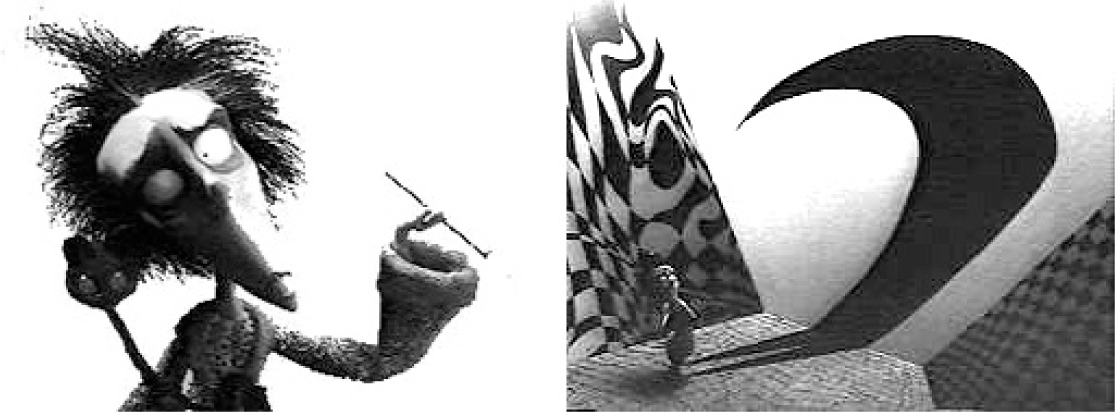
The role of the father is to instruct the child in norms-prescribing what is permitted and what is forbidden-and the child’s internalization of this process constitutes identification with the father. From Burton’s early pieces like ‘Vincent’, ‘Ed Wood’, and ‘Pee-wee’s Big Adventure’ to ‘Charlie and the Chocolate Factory’, the protagonists generally fail to undergo this paternal identification. As a result, they remain socially unborn characters who have failed to enter the Symbolic Order (Fig. 1).
Because Tim Burton is one of the few genuine auteur directors who has carved out a highly idiosyncratic visual style, interpreting his films requires an understanding of his interior world. His films are never deliberately inscrutable or difficult. Rather, they approach subjects through an unconventional aesthetic, navigating a grotesque yet fairy-tale-like universe that sits precariously on the cult-classic borderline.
Preferring to capture truth within the unrealistic realms of cinema rather than perceiving objects exactly as they appear, Burton prioritizes the transmission of visual imagery over literal plot, forging a world saturated with the unexpected. Structurally grounded in postmodern aesthetics, his cinematic worldview dismantles conventional tropes by deploying bizarre makeup, special effects, ingenious set designs, and a cartoonish imagination-a vision rooted deeply in his childhood upbringing.
The master key to understanding his cinematic universe is his six-minute animated stop-motion short, ‘Vincent’ (1982). This single piece compresses 1920s German Expressionism, 1950s Hollywood horror, outsider sensibilities, fractured worlds, and the director’s own persona. Beginning with this debut, Burton’s hallmark bleakness, the whimsical humor generated by oddly maladjusted characters, and his compulsive daydreams begin to unfold in earnest.
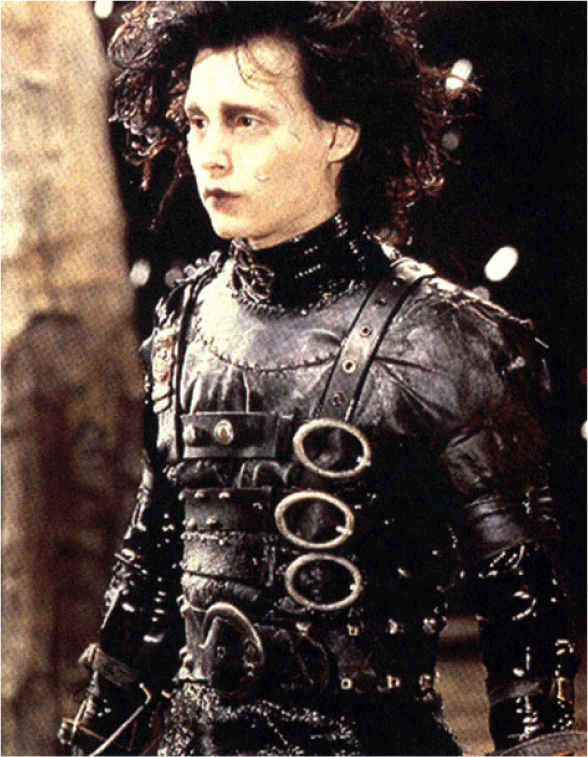
This motif of a fractured self and a split worldview is a core theme penetrating the entirety of Burton’s filmography. In his works, the successful elites and the mainstream society leading “normal” lives are almost always objects of satire, while the protagonists are outsiders dwelling in an abnormal world rejected by society. The main character of ‘Vincent’ appears to be an ordinary child to adults but has constructed an internal universe of horror. Meanwhile, Edward in *Edward Scissorhands* lives a secluded, isolated life, failing to adapt to society simply because he is not human (Fig. 2).
When the link between signifier and signified is severed, and the object that anchors signification (the Name-of-the-Father) vanishes, the subject breaks the Oedipal taboo. To fulfill its desire for the mother, the subject attempts a “displacement” and pursues Imaginary images instead. This mechanism, which negotiates desire and impulse at the boundary between reality and simulation, directly intersects with Lacanian theory. In the domain of “the Real,” as Lacan defines it, the subject of the Symbolic and the signifier cannot maintain a stable relationship. Ultimately, the most fundamental problem in human communication and relationship-building converges on this question: how are we to recognize and accept the existence of the other within such an imperfect structure.
In his personal memoirs, Tim Burton reflected on his early childhood as follows:
“I have loved fairy tales and myths since I was a child. The characters appearing in them are not realistic, yet they are deeply symbolic. On the surface, they seem bizarre and surreal, but once you understand their inner worlds, they reveal a completely hidden side.”
As this passage suggests, Tim Burton has consistently projected his own identity onto the villains and outsiders of his works. His films typically open with ghosts, demons, or monsters intruding upon quiet, peaceful spaces where one would never expect anything unusual to occur. The narratives are dominated by characters whose eccentric, ludicrous appearances prevent them from being viewed as ordinary humans. By utilizing individuals who exhibit non-human qualities despite being human, artificially engineered entities like Frankenstein’s monster, or literal phantoms and beasts, Burton simultaneously crafts an atmosphere that is surreal, chilling, and humorous all at once. Fairytale tropes-such as knights, witches, and Halloween pumpkins-are re-imagined through his lens into stylized symbols of the grotesque. Ultimately, Tim Burton’s unique aesthetic of the grotesque originates from his personal Oedipus complex, serving as a manifestation that has been transformed and restructured within the new visual environments and narrative frameworks of cinema (Fig. 3).
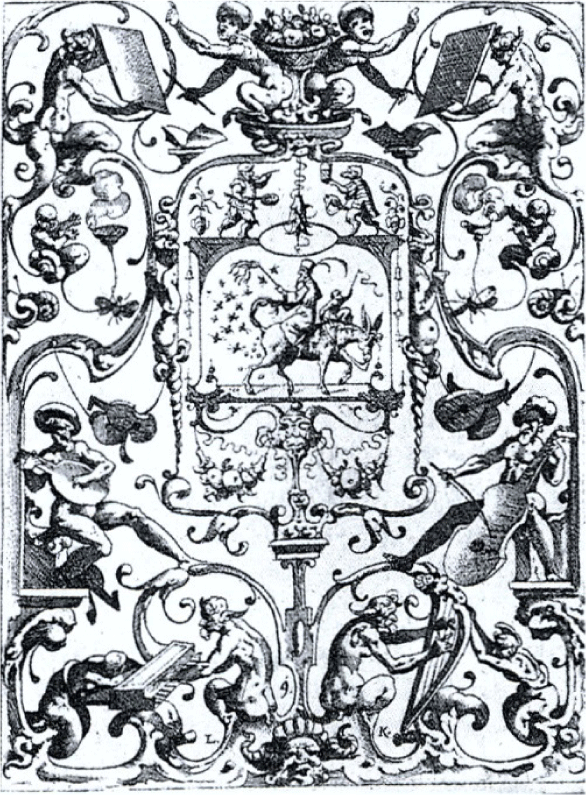
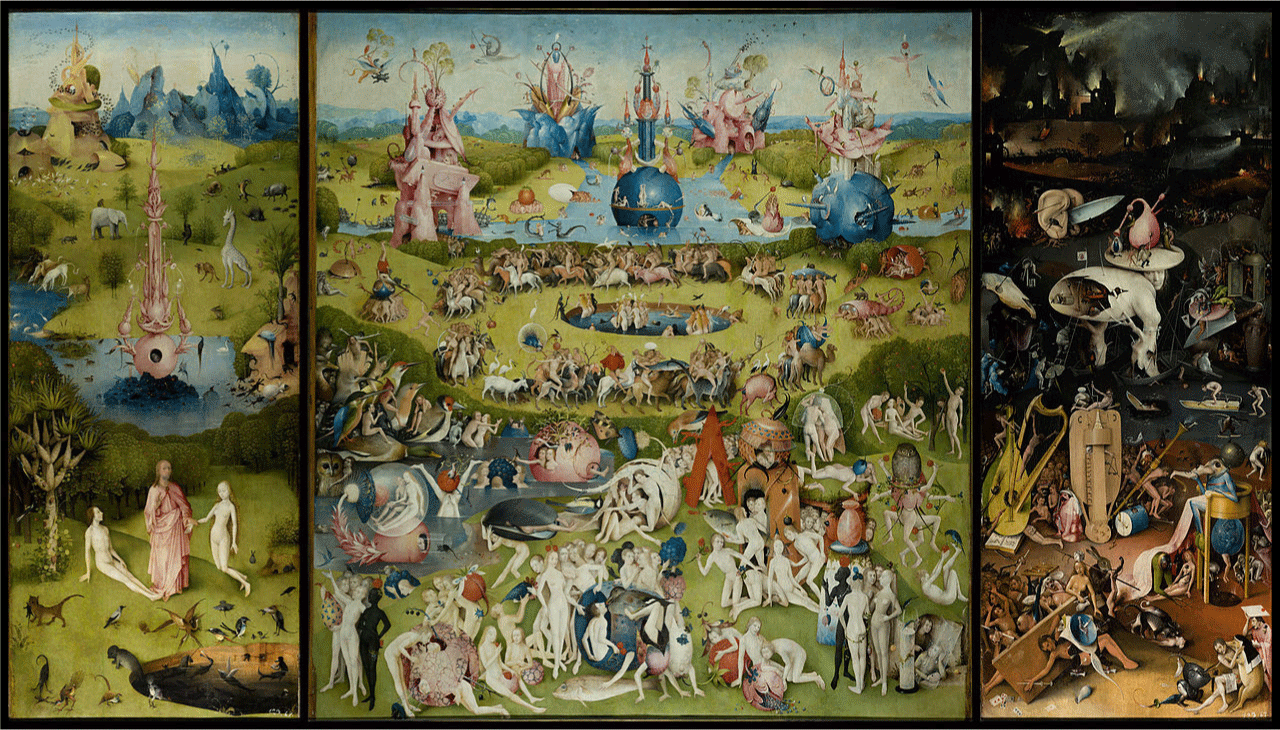
The historical roots of the grotesque run exceptionally deep in art history. The works of Hieronymus Bosch, a Northern Renaissance painter active from the late 15th to the early 16th century, are heavily saturated with bizarre and irrational imagery. His masterpiece, ‘The Garden of Earthly Delights’ depicts the Garden of Eden and Hell, showcasing not only hybrid monsters but also human bodies grotesquely fused with natural elements such as birds, fruits, flowers, and marine life. This vividly embodies the eccentric forms of ancient ornamentation, as well as the “grotesque conception of the body” characteristic of medieval and Renaissance carnival culture.
This trajectory subsequently evolved into the art of Surrealism. Profoundly influenced by Freudian psychoanalysis, Surrealism sought to record the unmediated flow of the unconscious, entirely bypassing the control of reason and transcending all aesthetic or moral prejudices. Surrealist cinema, which emerged in the late 1920s, similarly foregrounded uninhibited desires and fantastical wonderment, striving to dissolve the contradictory conditions of dream and reality into a state of so-called “Absolute Reality.” (Fig. 4).
The joy of a new stimulus or the fun of deviation turns into a “fear of the unknown” the moment the degree of abnormality crosses a certain threshold. When everyday norms are perceived to be severely threatened or assaulted, pleasure shifts into terror. Unlike mere humor or playful diversion, expression of the grotesque inherently carries this involuntary, coercive emotional force. It harbors a biting sarcasm, which, through an attitude of contempt and mockery toward its subject, occasionally develops into a form of diabolical play.
Despite its ubiquity as an everyday term, the concept of the grotesque remains ambiguous and opaque. From a formalist perspective, however, it bears the distinct characteristic of “deviating from the normal forms of objects.” Its constructive principles involve the blending of disparate elements, alongside distortion via transformation and exaggeration. This distortion possesses an ambivalence that simultaneously invokes visual pleasure and displeasure within a single form-a quality essentially linked to the grotesque principle of coalescing inherently conflicting elements.
In 1999, Tim Burton adapted the legend of the headless horseman, ‘Rip Van Winkle’ to present the film ‘Sleepy Hollow’. Set in the late 18th century during the height of the Gothic novel, the film accurately resurrects classic motifs of Gothic literature, including murder, witchcraft, the horseman of death, and witches. The film’s overall atmosphere and mise-en-scène are saturated with uncanny, Gothic imagery. In the opening sequence, a carriage racing through a dense forest of barren trees under a misty, blue moonlight establishes the visual tone and manner that dominates the entire piece.
This style of visual direction is also found in the stop-motion animated feature ‘The Nightmare Before Christmas’ (1993). In this work, Halloween Town is entirely blanketed in achromatic tones of black and gray. While backdrops in conventional films serve a secondary role to accentuate the characters, the backgrounds in this film leave the impression that the characters are floating inside a fantastical painting where only light and shadow exist. The bleak settings, such as cemeteries, the achromatic color palette, and the tall, gaunt trees that generate an aura of terror, are all part of Burton’s original visual rhetoric—the origins of which can be traced along the lineage of grotesque and Romantic imagery in Western art history.
The history of diverse experiments aimed at breaking free from visual spatio-temporal constraints and multi-perspective structures can be traced back to the spatio-perceptual transformations of imagery in Cubism. In the late Cubist works of Pablo Picasso, the artist shifts away from treating a stationary subject from a fixed point of view, instead capturing new perspectives through physical relocation. While critics might view this simply as an ideological reinterpretation of an image, it fundamentally adopts a “multi-perspective storytelling structure” that observes the subject from multiple directions and vantage points simultaneously, re-transmitting this polyphonic view to the receiver.
In visual media, shifts in perspective constitute both a foundational prerequisite and a methodological approach for constructing an image’s narrative. Nevertheless, because shifts in point of view have traditionally been perceived merely as a formalist mode of expression, their profound influence on imagery and narration has been somewhat marginalized. Walter Benjamin observed the transformation of visual systems brought about by the camera through a lens similar to Sigmund Freud’s map of the unconscious mind. Just as the unconscious is not non-existent but merely hidden, the same applies to the “optical unconscious.” Realms that previously existed but remained invisible to the naked human eye finally manifest through the aid of various optical apparatuses. It is when this unconscious worldview is actualized through the gaze of the camera that a sense of “the fantastic” is truly acquired, allowing the audience to intuitively comprehend and accept the camera’s point of view.
For Vertov, camera movement was not a simple variation of scale, angle, or viewpoint, but rather “the act of deploying and mixing images.” Because the velocity of movement dictates the relative relationship between objects, the psychological distance and perspective between images can be infinitely generated depending on the camera’s rate of acceleration. Furthermore, if velocity traverses the space between objects at extreme speeds, spatio-temporal distance is entirely obliterated. This camera dynamism provides humans with an alien yet completely unprecedented perceptual experience. While Aristotle viewed the discrete, tangible realities that humans can touch or feel as true reality, the evolution of visual media has expanded the concept of reality through mechanical apparatuses and montage. Vertov defined techniques such as time acceleration, close-ups, reverse motion, and shifting camera positions not as deceptive illusions, but as methods to perfectly harness ‘Cine-Facts’. He thus defined montage as “the act of writing” new meaning by organizing these cinematic fragments into a single, organic whole (Oh, 2005).
Generally, discussions of point of view in narratology depend heavily on grammatical person, famously classifying novelistic perspectives into first-person protagonist, first-person observer, third-person omniscient, and third-person observer. By clarifying the position of the narrator, these discussions establish types of narrative technique based on whether the narrator is identical to a character and to what degree they intervene in the story. Similarly, the transcendental symbolic forms that operate when the human mind structures the external world transform a passively received world of mere impressions into a dynamic world that is the product of the human mind itself. Furthermore, just as Erwin Panofsky classified the strata of meaning in an artwork into the three stages of pre-iconographical description, iconographical analysis, and iconological interpretation, interpreting cinematic images likewise demands a multi-angled approach to their visual layers.
The perspective actualized in film and digital imagery is not static like virtual reality (VR) images, but is continuously in motion. Just as the human eye cannot be pinned to a single point, an image cannot remain fixed either. Rather than reinforcing traditional linear perspective, this non-linear movement ultimately deconstructs perspective by expressing a dynamic, moving multi-perspective.
Consequently, the viewpoints and points of view deployed by Tim Burton can be defined as various modulations of the “Observer Perspective,” deliberately intended to meticulously control plot progression and foreshadowing throughout the process of cinematic image representation. On the surface, his visuals appear to offer a free-spirited, fantastical screen rooted in infantile thinking and childhood innocence. Beneath this sophisticated process of image representation, however, he continuously deploys grotesque, multi-perspective images, thereby presenting the audience with an unfamiliar yet enchanting visual experience.
Tim Burton’s film analysis
The foundational prerequisite for actualizing ‘Alice in Wonderland’ as a cinematic text is the “fantastical” quality of its imagery. Leveraging this fantasy as a medium, the film adopts a narrative structure that subverts pre-modern values and manifests a progressive archetype of women. Lewis Carroll’s original text, ‘Alice’s Adventures in Wonderland’ follows the daydream of a young Alice who accidentally tumbles into an underworld via a rabbit hole while pursuing a white rabbit checking its pocket watch. Conversely, the sequel, ‘Through the Looking-Glass’ utilizes the rules of a chess game as its structural backbone, meticulously calculated by the author, who was himself a mathematician. This sequel more vividly demonstrates abrupt spatiotemporal shifts and a reality-subverting antinomy through the framework of a looking-glass world.
Tim Burton’s film Alice in Wonderland exquisitely synthesizes the settings of both original texts while infusing a novel conflict structure and gaze through formalist transformation. The most significant divergence lies in positioning Alice as a nineteen-year-old adult, rather than the young girl of the source material. Feeling stifled by the patriarchal conventions and oppressions of the real world, Alice re-enters Wonderland while pursuing the white rabbit she happens to rediscover. Following a prophecy that she is the sole entity destined to rescue a corrupted Wonderland, Alice breaks free from the mold of a passive observer to grow into a warrior, reinventing herself as an autonomous and proactive female archetype. While borrowing Lewis Carroll’s structure of fantastical daydreams, this evolution culminates in the realization of a subversive character who overcomes real-world constraints through the subject’s active agency (Fig. 5).
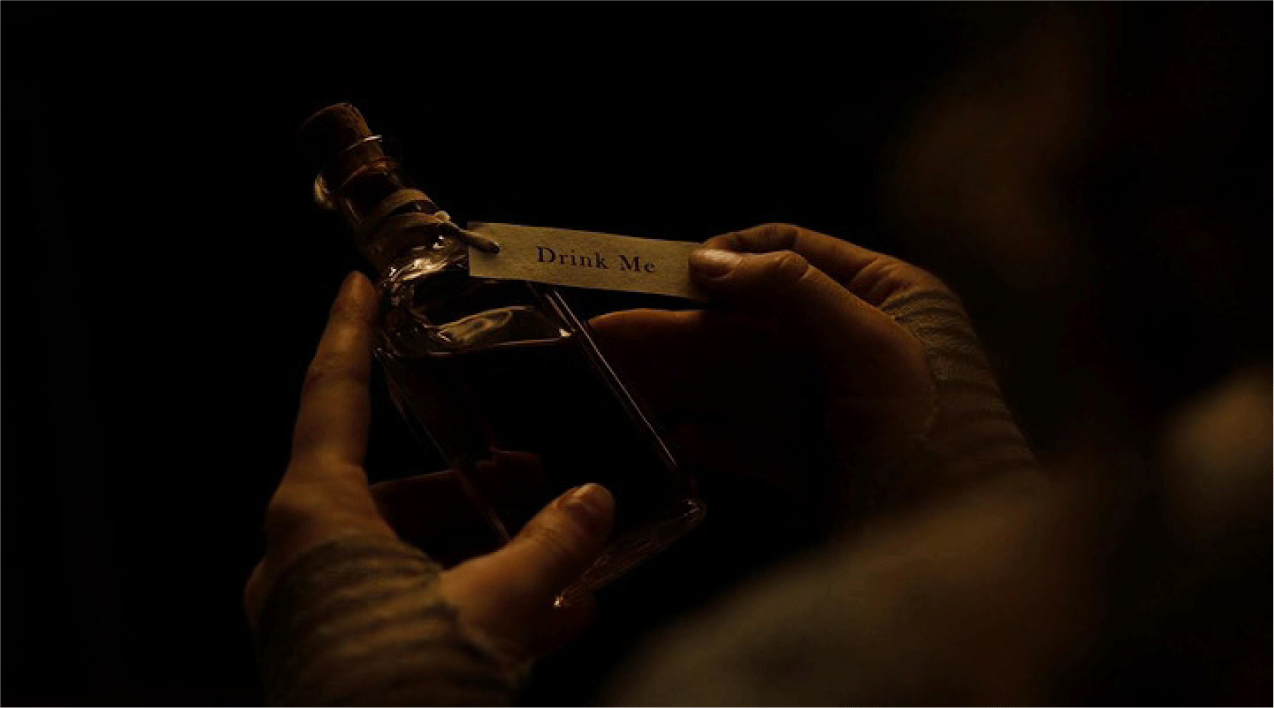
In Tim Burton’s cinema, space is bifurcated into the real world and its antithetical fantasy space (Underland). What is compelling is that while most of Burton’s films construct an unambiguous boundary between reality and fantasy through intense color contrasts, this particular work exercises restraint regarding such artificial chromatic oppositions. The real-world space faithfully reflects its historical backdrop (the Victorian era) while minimizing visual distortions, whereas Wonderland is represented through his hallmark grotesque imagery, causing the aesthetic textures of both spaces to eerily overlap.
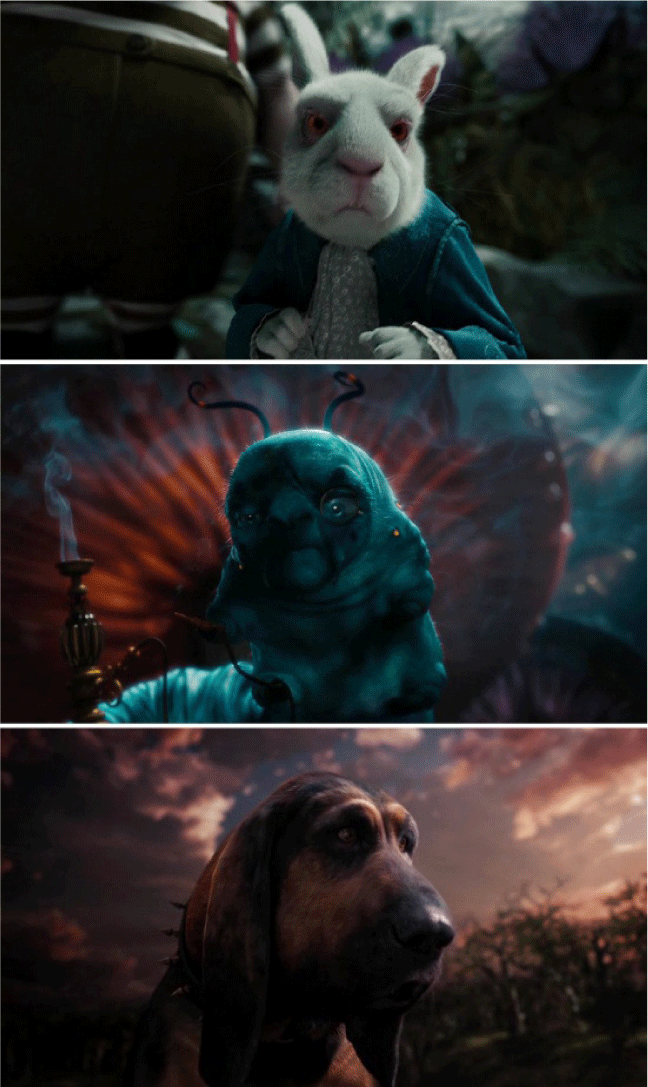
The mimetic mechanism operating within the film Alice in Wonderland transcends mere formal imitation. The very transformative process of elevating mute objects or animals into entities capable of reasoning and communicating on equal terms with humans constitutes a highly sophisticated, mimetic restructuring. For instance, the scene where the caterpillar Absolem-who functions as the wise sage in the narrative-undergoes a complete metamorphosis into a butterfly and flies away, only to reappear at the film’s conclusion on a ship in the real world, exemplifies a quintessential “ego-replicating mimesis via spatial relocation.” Though its form and dimension have transformed, the essential attribute of wisdom held by the caterpillar is seamlessly transferred and sustained within the real-world butterfly.
Accordingly, the narrative-where animals (the white rabbit, the cheshire cat), insects (the caterpillar) and objects (playing cards) assume human traits or act with autonomous intelligence while traversing the boundaries between the ordinary world and Wonderland-can be deeply interpreted within the context of ‘Xiaoyaoyu’ (free and easy wandering) and ‘Wu Wo Yi Ti’ (the unity of subject and object) as paradoxically championed by the Eastern philosopher Zhuangzi. In Zhuangzi’s philosophy, ‘Wu Wo Yi Ti’ signifies a state of absolute freedom where the distinctions between subject and object, or human and nature, dissolve into a singular fusion. The process through which Alice breaks free from real-world norms and undergoes bizarre transformations (such as fluctuations in her physical size) yet entirely accepts and communes with the creatures of Wonderland without any resistance is the very aesthetic of ‘Wu Wo Yi Ti’ actualized on screen (Fig. 6).
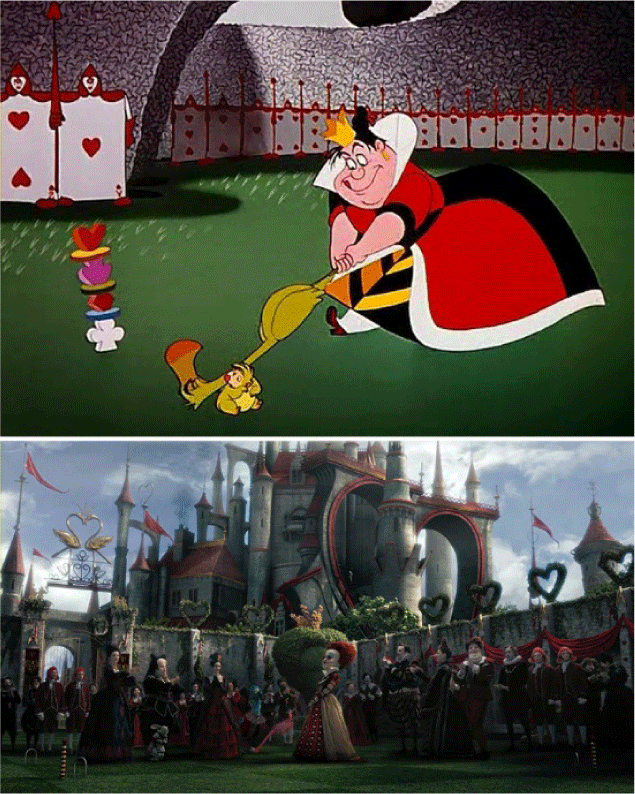
Furthermore, Zhuangzi’s ‘Xiaoyaoyu’ (free and easy wandering) signifies an absolute state of spiritual liberty-wandering freely without being shackled by any mundane values, secular institutions, or socio-cultural conventions. At the film’s climax, Alice does not merely eliminate a human adversary or engage in a conventional war for political power; rather, she resolves the structural conflicts of the realm by slaying the Jabberwocky, the ultimate symbol of dread. Here, the Jabberwocky functions as a proxy for the tyrannical Red Queen’s authority and a manifestation of an artificially distorted ‘Wu Wo Yi Ti’ (the unity of subject and object) marred by greed and obsession. Conversely, Alice operates as the champion of the White Queen and an autonomous subject liberated from oppressive dogmas, serving as an emblem of ‘Wu-wei’ (inaction and nature) that restores the pure, unadulterated order of nature devoid of artificial contrivance. Ultimately, Tim Burton’s Alice in Wonderland maximizes cartoonish imagination and grotesque mise-en-scène standing as a cinematic text that most fantastically reinterprets the Eastern philosophies of ‘Wu Wo Yi Ti’ and ‘Xiaoyaoyu’ through the grammar of contemporary filmmaking (Fig. 7).
The film ‘Corpse Bride’ (2005) stands as a comprehensive distillation of director Tim Burton’s authorial worldview and his visual aesthetics that seamlessly traverse the boundaries between live-action cinema and animation. Rooted firmly in the visual tradition of German Expressionism, this aesthetic matrix exerts a profound influence on the film’s narrative structure. Reflecting the director’s ideological framework, the film deploys a mythical rhetoric by substituting the protagonist, Victor, into a role akin to the heroes of Russian folktales, thereby elevating a mythologized fable into an objective reality and a universal narrative. Burton demonstrates extraordinary directorial prowess in restructuring an existing, fictional tale through his hallmark historical backdrops and idiosyncratic storytelling. Consequently, audiences encounter a familiar pre-existing fable yet experience it as an entirely novel visual and narrative journey. Through this creative filtration, an external text is masterfully reborn as a quintessential “Tim Burton story.”
In stark contrast, Lord Barkis emerges as the narrative’s sole villain and the root cause of every misfortune within the plot. Following the classical trajectory of poetic justice, the film resolves all structural conflicts by orchestrating his ultimate punishment. The pastor merely provides the catalyst for the inciting incident (the failed wedding rehearsal) rather than acting as a central narrative axis, while Elder Gutknecht functions as a wise mentor and ally to both Emily and Victor. Meanwhile, the town crier, operating in the manner of a newsboy, delivers exposition directly to the audience, establishing the temporal setting while introducing a Brechtian alienation effect and comic relief that paradoxically deepens viewer immersion.
Examining the precise dynamics between these characters reveals complex alignments. Bound by an arranged betrothal, Victor and Victoria validate their mutual, innocent affection during their brief rehearsal; yet, before they can cultivate a deeply synchronized emotional bond, they are swept into a radical vortex of events. Conversely, the relationship between Victor and Emily is initiated entirely by mistake via a forest vow. However, as the soft-hearted Victor begins to sympathize with Emily’s tragic history, their bond gradually evolves into a genuine emotional allegiance. In the resolution, Emily drives the ultimate plot twist by selflessly relinquishing Victor to Victoria. Her subsequent reincarnation and sublimation into a butterfly beautifully illustrate the profound reciprocity of a relationship built on deep empathy for the other.
The dynamic between Lord Barkis and Victor is a textbook adversarial conflict. Cornered during a violent, avaricious duel with Barkis, Victor faces imminent doom. He is rescued only by the re-emergence of the poisoned wine goblet-originally introduced as a calculated plant in the narrative’s first half-which resurfaces as a payoff to destroy Barkis. This resolution mirrors the classic David-and-Goliath motif, mythologizing the protagonist as the underdog who conquers an overwhelming oppressor. The bond between Barkis and Emily is strictly defined as one between victimizer and victim. The late-stage revelation that Barkis was the very scoundrel who seduced, murdered, and robbed Emily in the past allows her to finally purge her lingering resentment and attachments to both the terrestrial and post-mortem realms, clearing her path toward butterfly sublimation. Finally, Barkis’s relationship with Victoria is entirely predatory. Following Victor’s sudden disappearance, Barkis proposes to Victoria to seize her presumed family wealth, only to suffer immediate disillusionment upon discovering their complete bankruptcy. Driven by unyielding avarice until his final breath, he inadvertently drinks the poisoned wine and orchestrates his own demise.
This horizontal network of relationships among the deceased and living can be explicitly decoded through AJ Greimas’s semiotic binary of “Open versus Closed” spaces. While Victor serves as an open, mediating agent who garners affection from both women (Victoria and Emily), Lord Barkis stands in stark opposition as a closed medium-blinded exclusively by gold, utterly incapable of genuine emotional communication, and ultimately abandoned by all. This structural tension securely anchors the film’s entire narrative axis.
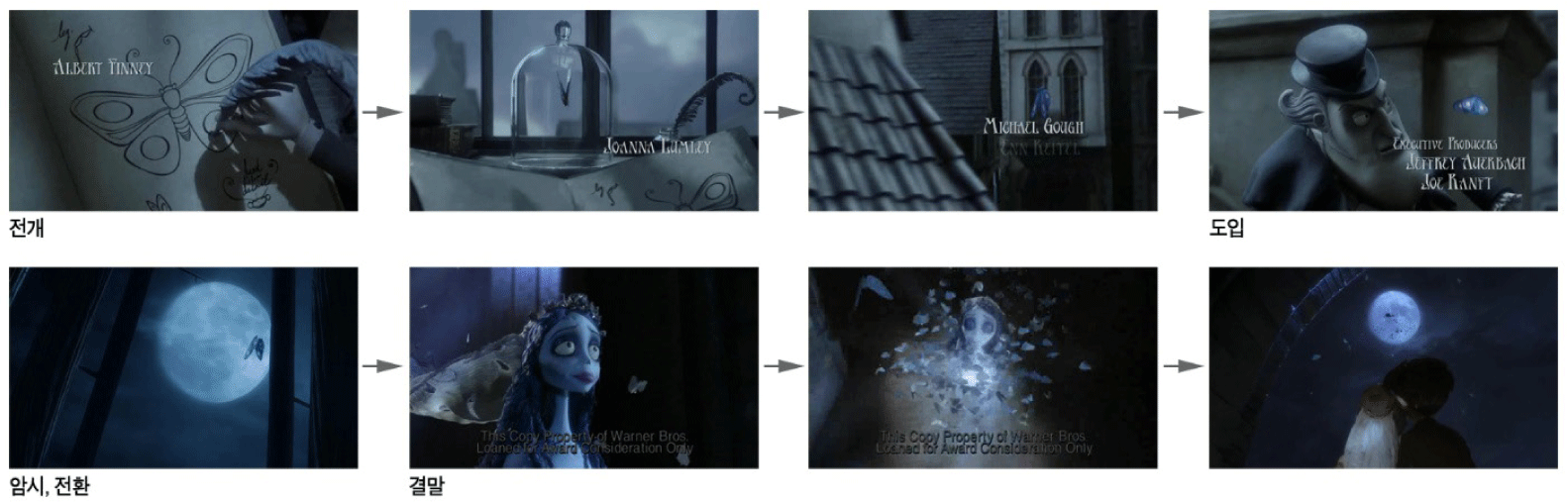
‘Corpse Bride’ adopts a narrative structure that is framed by the imagery of a butterfly from inception to conclusion. The butterfly that Victor meticulously sketches and subsequently liberates from a glass jar during the opening sequence traverses the bleak, terrestrial realm, immediately conveying the somber textures of the setting to the audience. This butterfly is visually mediated by the moon and linked to the maggot (Emily’s tiny companion, evoking Carroll’s Absolem), ultimately culminating in the fantastical resolution where Emily’s soul dissolves into an infinite cloud of butterflies. Thus, the butterfly functions as the foundational ideological metaphor running through the entire work.
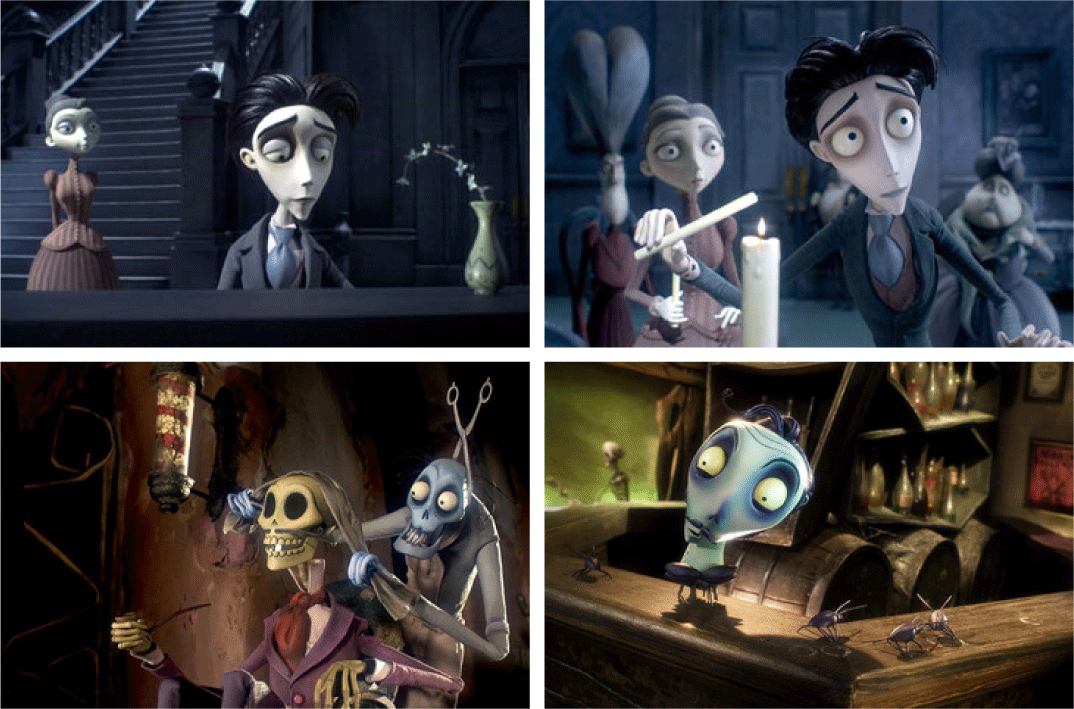
Within this framework, the spatial architecture of *Corpse Bride* is strictly bifurcated into the “Land of the Living” (the mundane reality) and the “Land of the Dead” (the post-mortem realm). Phenomenologically, space and time are identical; the mode of a space’s existence is its time. Although the separation between these two domains is rigorously structured, their spatiotemporal boundaries are made fluid through transitional devices, such as Victor’s deceased pet dog, Scraps, or Elder Gutknecht’s sorcery. Reconnecting with Victor in the afterlife, Scraps performs a vital semiotic function: proving that the realm of death is by no means an inherently bleak abyss, but can instead exist as a joyous, kinetic, and vibrant space.
The color-driven mise-en-scène dramatically subverts this spatial duality. Traditionally, the terrestrial realm-which should symbolize life (Eros)-is rendered in a barren, monotonous, and severe low-saturation palette of cool monochromes. Conversely, the subterranean afterlife-the structural domain of ‘Thanatos’-is staged in brilliant, saturated primary colors brimming with vitality. The stark, high-contrast lighting and achromatic tones of the living world are a direct reflection of German Expressionist aesthetics. Additionally, in a witty homage to the legendary stop-motion master Ray Harryhausen, Burton inscribes the animator’s name onto the brand logo of the piano that Victor plays.
To construct this mythic narrative, Burton mobilizes a sophisticated array of rhetorical figures, including metaphor and metonymy. From a directorial standpoint, however, one critical nuance must be observed: the state of absolute chaos generated during the confrontation between the living and dead realms is narratively obscured rather than rigorously unpacked. Consequently, the situational context of the plot remains fundamentally dependent on the binary rhetoric of the two worlds. Had the visual color contrast between the vivid primary hues of the afterlife and the monochrome tones of the living world been absent, this spatial demarcation would have collapsed entirely, severely compounding narrative confusion for the audience. Ultimately, Corpse Bride can be evaluated as a triumph of visual rhetoric, wherein potential vulnerabilities in narrative logic are successfully concealed and fortified through a flawless visual mise-en-scène (Table 1, Fig. 8).
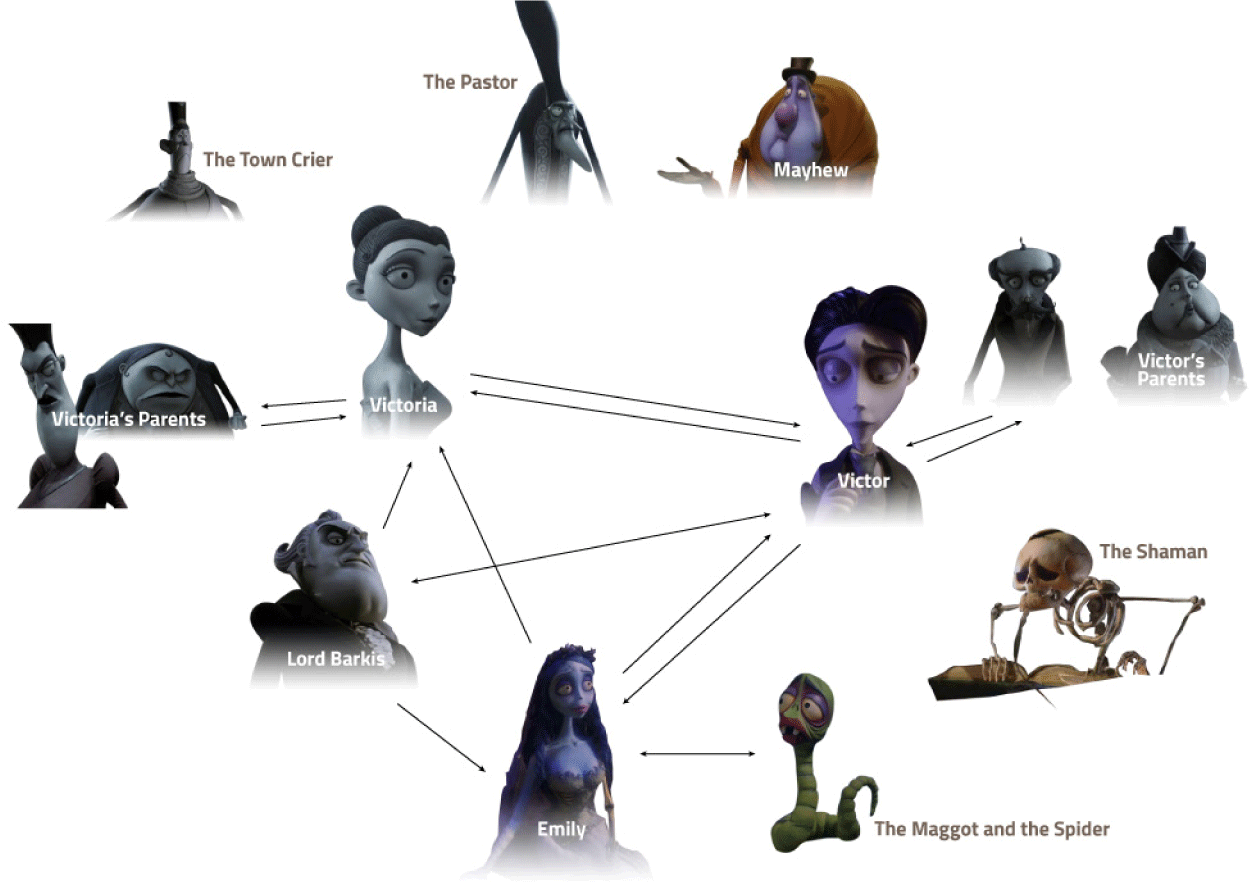
The initial character dynamic is established through the engagement of Victor and Victoria. Meeting for the first time during a wedding rehearsal, they gradually confirm their mutual affection; however, constrained by the film’s limited runtime, their relationship undergoes a rapid and compressed progression.
In ‘Corpse Bride’ the primary character network is defined by a central antagonism between Victor and Lord Barkis. Meanwhile, Emily and Victoria share a shared destiny, while the triad of Victor, Victoria, and Emily functions as a complementary system. Victor and Victoria’s bond represents a fateful alignment that underscores the necessity and legitimacy of their union. The relationship between Lord Barkis and Emily is structured around a victim-perpetrator dynamic, identifying Barkis as Emily’s murderer. Concurrently, Barkis and Victoria form a subsequent victim-perpetrator dynamic; despite their marriage, before their first night has even passed, Barkis’s overt financial greed reveals his complete disregard for Victoria.
The specific “Relational Configurations” among these central characters constitute a coherent narrative structure, forming the core axis of the entire cinematic storytelling. Rather than operating within a unidirectional, hierarchical framework, the four protagonists engage in a horizontal network characterized by mutual complementarity and distinct antagonism (Fig. 9).
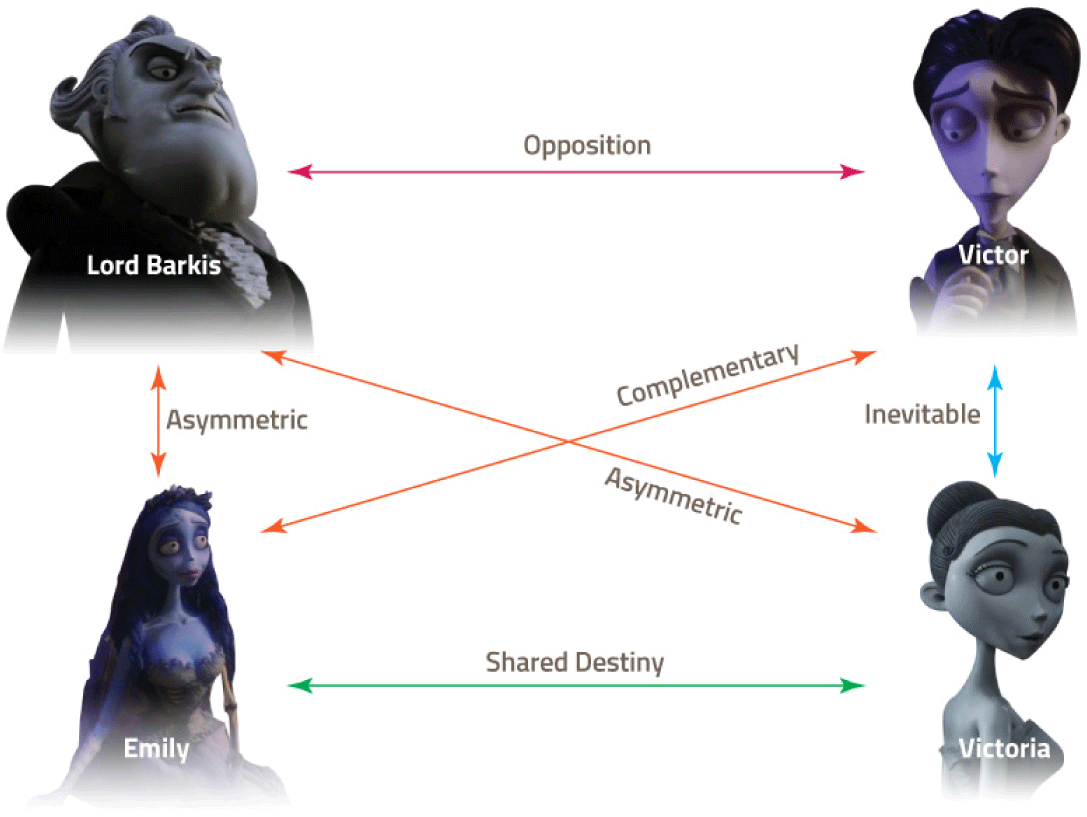
The relational dynamics among these characters can be effectively elucidated through the law of openness versus closure in Greimasian semiotics. Within this framework, Victor functions as an open medium, whereas Lord Barkis operates as a closed medium, thereby structuring the overarching narrative arc.
As a manifestation of open space, Victor simultaneously elicits mutual affection from both Victoria and Emily. Conversely, embodying closed space, Lord Barkis exists as an isolated figure, ultimately rejected by both female protagonists. This structural opposition is further reinforced by Barkis’s intrinsic motivations; he exhibits complete indifference toward these characters, positioned structurally as an antagonist blinded exclusively by monetary avarice (Figs. 10 and 11).
The film ‘Sweeney Todd: The Demon Barber of Fleet Street (2007)’ is based on source material previously adapted into cinema in 1936 by British director George King. Tim Burton conceived this project after being deeply inspired by a Broadway musical performance he attended in New York approximately a decade prior. By synthesizing the inherently dramatic structure of the musical with cinematic mise-en-scène, Burton accomplished an experimental thriller of a novel format. Although Burton had intermittently integrated musical elements into his preceding filmography, ‘Sweeney Todd’ marks his definitive transition into a phase where the realism and atrocity of dramatic situations are maximized.
Violence, which encompasses not merely physical force but also verbal and psychological oppression, inherently possesses a negative attribute that severs constructive communication with the Other, enforcing unilateral subjugation and destruction. Crucially, however, the violence depicted in ‘Sweeney Todd’ paradoxically accommodates a dimension of “the fantastic.” Rather than becoming submerged in the visceral brutality characteristic of the gore genre, Tim Burton filters the fantastic essence of violence through meticulously controlled mise-en-scène and sophisticated visual direction. This formalist approach refrains from eliciting mere revulsion or horror; instead, it induces the spectator to fully immerse themselves in the protagonist’s profound melancholia and retributive desire. As media theorist Paul Virilio observes, intense visual spectacles deliver a form of fascination and pleasure via artificial neurological stimulation. Burton adroitly executes this neurological stimulation of the spectacle by purifying the cruelty of violence through Expressionist techniques (Ahn, 2009).
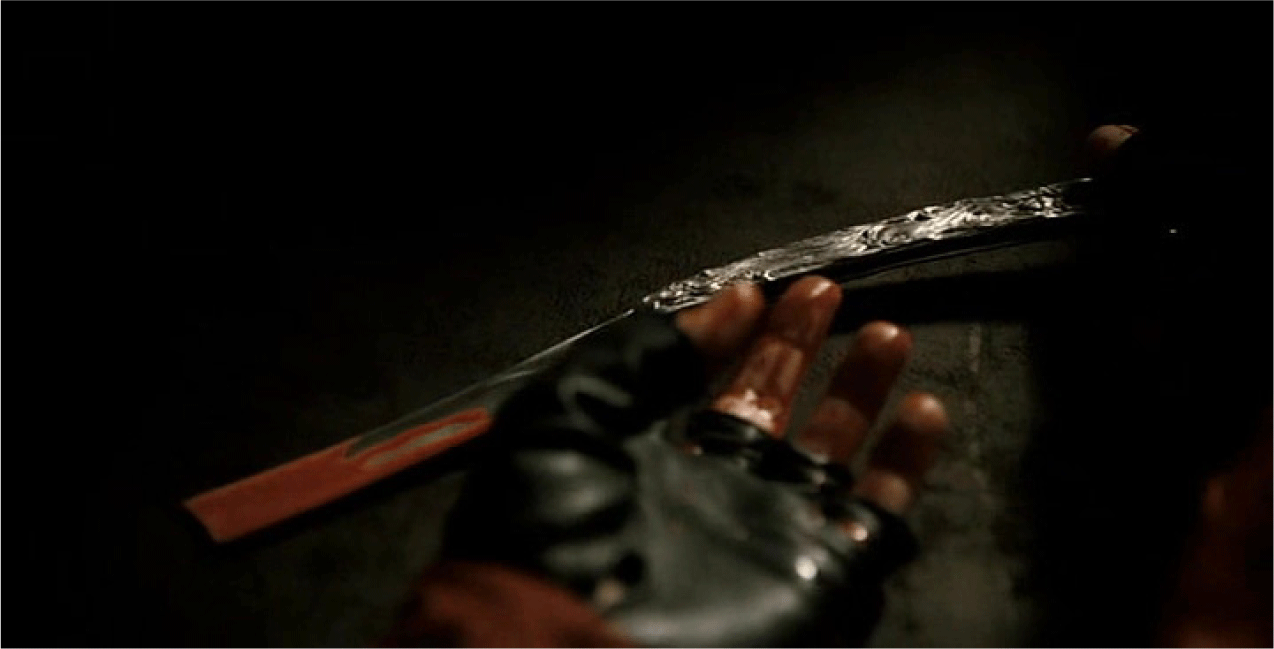
Furthermore, ‘Sweeney Todd’ activates the fantasy of violence mediated through the cold object of the straight razor, thereby constructing an eminently grotesque color palette. Notably, this explicit violence remains oddly restrained, deliberately uncoupled from “Sexuality,” which is otherwise a conventional prerequisite of the grotesque. This intentional exclusion of sexual stimuli aligns precisely with the pure human idealism pursued by Burton; it functions as an intellectual apparatus that regulates the visceral immersion of the audience, thereby compelling them to navigate the narrative’s underlying allegory (Fig. 12).

The British Industrial Revolution, which serves as the socio-historical backdrop of the film, was an era characterized by the polarization of wealth and the eradication of human dignity by capital. The bourgeoisie monopolized legal and institutional frameworks to distort foundational value systems, while the impoverished class was compelled to conform to collective irrationality merely for survival. The aberrant social structure depicted through the character of the young child, Toby, who consumes potent alcohol under the tacit, naturalized connivance of adults, sharply projects the corrupt societal mores of the period.
Furthermore, the film positions the ancient custom of consuming human flesh-namely, “Cannibalism”-at the forefront of its narrative to interrogate the hypocrisy of the civilized world and the boundaries of human nature. As Herman Melville critically exposed, Western humanistic civilization professes love and the common good, yet conceals a barbaric essence grounded in predatory avarice and consumption beneath its surface. The binary perception that demarcates raw action as savagery and artificial processing as civilization is fundamentally deceptive. In a manner structurally analogous to VR, which exhibits a structural contradiction by being simultaneously recognized as both an illusion and an existing reality for the spectator, “Mrs. Lovett’s Meat Pie Shop” functions as a paradoxical space enjoying a legitimate, commercial boom in the very heart of a civilized metropolis (Kim, 2007).
The pie shop, which previously lacked both ingredients and flavor, achieves an overnight commercial triumph through the horrific crime of incorporating human flesh. The public’s blind predatorial behavior and addictive tendencies, concealed beneath the veneer of civilization, nakedly expose a fragmented society whose values have utterly collapsed. Crucially, however, the protagonist, Sweeney Todd, exhibits total indifference toward the financial success of the shop or mundane worldly affairs; instead, he remains exclusively consumed by honing his retributive blade against the Judge. This radical detachment from social ethical consciousness serves as a narrative foreshadowing that accelerates the dissolution of his ego.
While the central narrative is dominated by the external plot of revenge, the internal psychological conflict is configured at a psychoanalytic stratum that deconstructs the conscious structure of the self. This internal dynamic bears a profound philosophical probability with the parable of *Pao Ding Jie Niu* in Eastern Zhuangzi philosophy. Within the ‘Pao Ding Jie Niu’ allegory, Pao Ding’s act of comprehensively deciphering the bovine anatomy to dissect flesh from bone transcends mere butchery technique; it signifies the attainment of *Dao* (the way), characterized by absolute detachment and alignment with natural cosmic principles. Consequently, Pao Ding’s blade and Sweeney Todd’s straight razor operate as identical structural mediums and symbolic apparatuses for deconstructing subjects.
However, whereas Pao Ding attains the realm of ‘Dao’-the consummation of life-through his blade, Todd’s deconstructive approach and technical expertise construct an incomplete, destructive semantic framework. Diverging from his original identity as the once-benevolent barber “Benjamin Barker” the subject is reincarnated into an irreversible, dual alter-ego: Sweeney Todd. Although he endeavors to execute an immaculate act of retribution, he is ultimately blinded by the frenzy of violence, confronting extreme imperfection as he unwittingly murders his own wife, whom he was destined to salvage.
The alter-ego, a recurrent motif in German Expressionist cinema, represents an illusory form birthed by the media condition dominating human anatomy and perception. Failing to overcome the dualistic anguish of reality, Sweeney Todd ultimately meets his demise within the cruel, self-inflicted shackles of karmic retribution. Paradoxically, it is exclusively through this tragic death that he ceases the torment of his fractured ego and achieves liberation. The film presents a profound allegory wherein Todd finally retrogrades into the absolute realm of ‘Dao’-as manifested in Zhuangzi’s ‘Pao Ding Jie Niu’-a state of nothingness where all obsession and defilement are entirely annihilated (Fig. 13).
Conclusion
Zhuangzi, a prominent Eastern thinker who advocated for the renunciation of avarice and a retrograde return to a life of non-action (Wu-wei), was a practical philosopher who embodied the unity of knowledge and action. Guided by his own volition and structural values, Zhuangzi refined his ideological foundation by prioritizing the realization of ‘Wu-wei’ and a relativistic value system. His philosophy constitutes an unfathomably deep ocean of contemplation, operating fluidly because it evades rigid dogmatism, continuously positioning “Relativistic perspective” and “Relativistic practice” at its core. From this conceptual locus, Zhuangzi’s ‘Wu-wei’ is not a mere abstraction but an archetypal mode of existence that he actively practiced and playfully navigated. This ideological core is explicitly articulated and segmented within the Inner Chapters of his text, notably in “Xiaoyaoyu” (carefree wandering), “Qiwulun” (on the equality of things), and “Yangshengzhu” (the principle of nurturing life).
In particular, Zhuangzi demonstrated exceptional intuition and aesthetic approaches toward images among ancient Chinese thinkers, frequently elucidating empirical perspectives on imagery. The famous parable of “Zhuangzi’s Butterfly Dream” in “Qiwulun” which deconstructs the boundary between reality and dream to articulate the fusion of subject and object, clearly delineates a novel dimension of the spiritual realm through the representation of images and the chaos of phenomena. Furthermore, “Xiaoyaoyu” which inaugurates the Inner Chapters, aspires toward the praxis of a carefree existence, liberated from secular desires and psychological defilements.
The aesthetic symptoms permeating Tim Burton’s cinematic universe are distinct: first, the deployment of a specific low-saturation color palette grounded in Expressionist stylization; second, the proliferation of grotesque imagery dominating the overarching visual narrative. His films predominantly manifest monochromatic, dark, and turbid low-saturation mise-en-scène, a formal choice closely intertwined with the socio-historical backdrops of the analyzed works—specifically, the periods surrounding the British Industrial Revolution, which were rendered bleak by materialism and the polarization of wealth. Yet, Burton transcends mere bleakness; at pivotal narrative junctures, he introduces a visual modulation by juxtaposing highly saturated, vibrant colors that evoke a piercing visual contrast.
Amidst this juxtaposition of images, the consistently maintained grotesque imagery shapes the unique atmosphere of his entire filmography, spanning ‘Alice in Wonderland’, ‘Corpse Bride’ and ‘Sweeney Todd’ as well as ‘Charlie and the Chocolate Factory’, ‘Big Fish’, and his early short film ‘Vincent’. Characteristically, while Burton adopts the formal architecture of the grotesque, he rigorously expunges “sexuality”-an excess traditionally deemed a prerequisite of the grotesque. Whether this represents a containment of moral concepts or the director’s intrinsic fairy-tale ethos remains ambiguous; nonetheless, his imagery, stripped of sexual stimuli, radiates a pure naturalistic disposition at the very apex of visceral violence. This mechanism of regulating peripheral stimuli to purify primordial emotion functions as an artistic ideology, establishing a clear convergence with Zhuangzi’s philosophy of ‘Wu-wei’.
Cinema is, inherently, a “reproduction of the imagination” that utilizes audio-visual mediums to reconstitute memory. By visualizing a fantastical dimension and a utopian locus detached from the quotidian, cinema offers the spectator more immediate accessibility than literature or music. Although contemporary technological advancements have flawlessly actualized realms of imagination previously deemed impossible, they have concurrently birthed limitations, occasionally obfuscating narrative causality or concealing acute structural conflicts behind visceral visual stimuli. At this intersection, Burton stands as an unparalleled auteur who has secured both commercial success and critical authority by synthesizing technical precision in image reproduction with an eccentric “fairy-tale imagination.” Aggregating his visual paradigm yields a narrative of liberation: the reproduction of grotesque imagery, the visual aesthetics of a fairy-tale imagination, and the sublimation of sadism, anxiety, and melancholia into a liberated, playful expression.
‘Alice in Wonderland’ visually reproduces Zhuangzi’s concept of ‘Wu Wo Yi Ti’ through an illogical spatial configuration and the establishment of a utopian locus. The attribute wherein rare fauna and objects articulate human language and act as autonomous agents is accepted as a natural, self-evident order precisely because the space is a “Wonderland” liberated from realistic norms. Communing with these holistic objects induces a cognitive awakening within the subject, Alice. Just as the butterfly and the self coalesce into a singular entity in the “Butterfly Dream” parable, the artificial boundary between reality and utopia is dissolved within the fantastic world constructed by kinetic objects and loquacious animals. Ultimately, the locus Alice attains is a realm of absolute spiritual freedom untethered by secular values or institutional frameworks’ precisely mirroring the universe of ‘Xiaoyaoyu’ and the ideological framework of ‘Wu Wo Yi Ti’.
In ‘Corpse Bride’ a maggot resides within the anatomy of Emily, maintaining a symbiotic relationship. Transcending the role of mere comic relief, this maggot functions as a biological motif and narrative justification for Emily’s ultimate metamorphosis into countless butterflies at the resolution. Although the living subject, Victor, initially fears the deceased Emily, his experience of the underworld transmutes this dread into empathy and comprehension, constructing a novel relationship that deconstructs the boundary between life and death. The subgeneric structure of the narrative, which initiates with a singular butterfly and terminates with the sublimation of Emily’s soul reincarnating into a kaleidoscope of butterflies, aligns seamlessly with “Zhuangzi’s Butterfly Dream” The butterfly is an ontological entity that overcomes morphological defects via metamorphosis into an entirely distinct organism. Burton’s penchant for utilizing the butterfly as a primary motif serves to center the formation of a novel alter-ego and the dimensional transition of the soul, through which the audience experiences a Zhuangzi-esque liberation where the mortal realm, the underworld, reality, and utopia beautifully coalesce.
Similarly, while *Sweeney Todd* is saturated with sanguinary tragedy and sadistic behavior, peeling back this cruel surface veneer reveals an intrinsic connection to the parable of ‘Pao Ding Jie Niu’ in ‘Yangshengzhu’. Pao Ding’s act of flawlessly dissecting the bovine anatomy signifies the epitome of expertise penetrating the essence of the subject; it is a praxis leading to the “Dao of nurturing life,” which preserves existence by aligning with natural cosmic principles. The socio-historical setting of the British Industrial Revolution-rife with oppressive feudalistic remnants and the absurd abuse of power-shares a narrative context with the chaotic Warring States period during which Zhuangzi consolidated his philosophy. Within the cannibalistic tragedy wrought by the avarice of Mrs. Lovett and the barber Sweeney Todd-who lost his core identity due to a fraudulent conviction-Todd’s “straight razor” operates as a technical instrument of dissection and a fatalistic medium severing historical memory. Although Todd, blinded by a frenzy of violence, ultimately fails to achieve absolute salvation and confronts a destructive demise, the film demonstrates that the torment of his fractured ego is terminated exclusively through this catastrophic death. Thus, by relinquishing obsession and retrograding into a state of nothingness through a paradoxical demise, the film accomplishes a harsh, agonizing cinematic variation on the “Dao of nurturing life” completed via the blade.
In conclusion, while Zhuangzi articulated the absolute truth of ‘Wu-wei’ he perpetually emphasized “relativistic consideration and the transposition of perspectives” for humanity navigating the mortal world. Zhuangzi’s philosophy does not remain a static aesthetic text; it is a wise philosophy of praxis that implores individuals to empirically experience and awaken to the myriad situations encountered within the sea of existential suffering. Through the Western cinematic medium, Tim Burton deploys his signature grotesque mise-en-scène and fairy-tale imagination to demonstrate-in the most fantastical manner in contemporary cinematic history-the philosophical propositions that Zhuangzi so ardently sought to attain: the reverence for relativistic values, the blending of reality and ideal, and the retrograde return to a ‘Wu-wei’ stripped of artificial avarice.

